
[VIDEO]: Why You Should Take my Philosophy of Education Course this Fall

EPE 640 is offered this fall, 2019

Graduate students and advanced undergraduates at the University of Kentucky, watch this VIDEO (4m29s) about why you should take my EPE 640 course this fall on the Philosophy of Education.

Photo with students at the University of Mississippi.Advanced undergraduates, if you’d like to take this course, email the instructor at eric.t.weber@uky.edu.


Why study the Philosophy of Education?

a) Educators and leaders are expected to have a meaningful grasp of their own philosophies of education;

b) All research is rooted in frameworks of ideas that support and contextualize our work and thought, and that can clarify and help us to focus or be conflicted and confuse us if not carefully considered;

c) Everyone working in educational administration contributes to a system that functions with respect to or in conflict with underlying philosophical ideas. That calls for appreciating and always keeping in mind what we ought to be doing in education.

What you’ll get out of it / create:

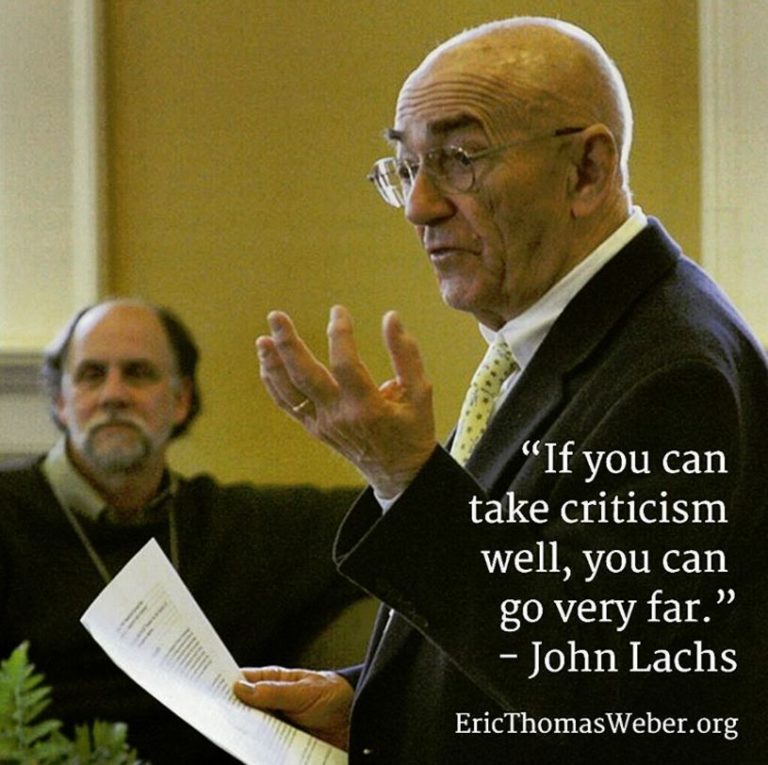
Eric Thomas Weber, author of "Uniting Mississippi: Democracy and Leadership in the South" speaks at Sturgis Hall October 19, 2015. Photo Credit: Jacob Slaton

Photo Credit: Jacob Slaton

1) A short “teaching statement,” “Statement on Philosophy of Education,” or related document commonly requested in academic job applications, as well as for administrative positions that often involve teaching courses or otherwise supporting them;

2) A book review for possible publication;

3) A conference-length paper ready for submission to professional calls for papers;

4) A full-length research paper suitable for submission to journals and that could support your other projects;

John Dewey, standing.

John Dewey, concerned that you’re not yet signed up for the course.

5) An op-ed-length version of the research paper for possible submission to newspapers or educational periodicals;

6) Credits that can contribute to the Graduate Certificate in College Teaching and Learning.


When & Where?

It’ll be on Wednesdays from 11am-1:30pm in Dickey Hall rm 127.


Questions? Email me at eric.t.weber@uky.edu. You can also connect with me on Facebook, Twitter, LinkedIn, & Academia.edu.

A teacher holding a paddle used for corporal punishment.I’ll be giving a talk titled:

Moral and Political Arguments Against Corporal Punishment in Schools: On the Need for Democratic Discipline

Date: October 17, 2019
Time: 10:40-11:50 a.m.
Event: The Mid-western Educational Research Association Annual Conference, 2019
Topic: Corporal Punishment in Public Schools
Sponsor: The Midwest Educational Research Association
Venue: Kingsgate Hotel and Conference Center, Mt. Adams
Location: Cincinnati, Ohio
Public: Public
Registration: Click here to register.
More Info: Click here for more information.

‘Ethics & Public Policy’ course in Fall ’18

For the Fall semester of 2018, I’m planning an upper level course here at the University of Kentucky in ‘Ethics and Public Policy,’ PHI 531, Section 1, which will run on Tuesdays and Thursdays from 3:30 – 4:45 pm. The course will begin with an examination of major moral traditions as well as ethical problems that are special challenges for leadership in the policy sphere. We will then survey a variety of policy areas and documents in which moral consideration is deeply important and needed.

The Capitol Building in Washington, D.C.

A stack of newspapers.Areas of interest and application for the course will include:

  • Educational Aims & Policies
  • Mass lncarceration
  • Healthcare Ethics
  • Economic Development Policies
  • Climate Change
  • Human Rights
  • Research Ethics
  • Animal Rights
Image of a flyer for the course, featuring the information described on the present page.

Flyer for the course.

My former students who have studied ethics and public policy with me have gone on to work in the White House, under both the present and previous administrations, the House of Representatives and the Senate, the State Department, the F.B.I., the Heritage Foundation, the Center for American Progress, and numerous think-tanks, as well as a variety of offices in state government. There is need for study of the kind addressed in this course also for countless advocacy groups and organizations, as well as in current events journalism.

For those interested, here is the University of Kentucky’s page with information about how to register for courses for the Fall of 2018.

For those interested in more information now, you can check out my books on ethics and public policy, including:

Cover for 'Morality, Leadership, and Public Policy.'


Morality, Leadership, & Public Policy (London: Bloomsbury, 2010)


Photo of the paperback and hardback editions of 'Democracy and Leadership.'Democracy and Leadership: On Pragmatism and Virtue (Lanham, MD: Lexington Books, 2013)

and

Paperback editions featuring the cover of 'Uniting Mississippi.'Uniting Mississippi: Democracy and Leadership in the South (Jackson, MS: The University Press of Mississippi, 2015)


The logo for Philosophy Bakes Bread, which involves to slices of bread with tails, making them look like dialogue bubbles.In addition, for those who are unfamiliar, I co-host the Philosophy Bakes Bread radio show & podcast that airs on WRFL Lexington, 88.1 FM and in the show we cover a number of public policy topics. Give it a listen!

Better Late Than Never: Recent Review of my 2010 Book

Warning: This post is about a scholarly review of a pretty technical book.

Cover of 'Rawls, Dewey, and Constructivism.'The pace of academic work can sometimes seem tectonic. There’s a reason scholars tend to have a hard time appreciating what news editors mean by “timely.” For a philosopher, an argument about Plato that was published after the year 2000 is downright recent.

Keeping that in mind, I’m pleased to share with you the book review that has just been published of my first book, released in 2010, Rawls, Dewey, and Constructivism. It’s the first review of that book to come out in any of the major American philosophy journals, believe it or not. The book wasn’t ignored, I’m happy to say, having been reviewed very positively in 2011 in Notre Dame Philosophical Reviews. But, the Transactions of the Charles S. Peirce Society is a top notch outlet for one of my deep philosophical interests, namely American philosophy.

Photo of the cover of the Transactions of the Charles S. Peirce Society.

The best news about the review that has just come out is not any glowing language about my book. The tone of the review is very matter of fact and balanced. The fantastic thing is the quality of this review.

A good review has to tell you in some precise detail about the aims, structure, and substance of the book to be reviewed. It also should raise notes about both what were some strengths in the project and what could either be improved or extended in future work. In his review, Torjus Midtgarden of the University of Bergen has seriously inspired me in a highly unusual way. He’s made me want to return to the study of the subject of my dissertation.

View of a sunset through a rear view mirror.Most people finish their dissertations and don’t want to look back. Not only did I look back in the years after defending it, but I did the traditional thing some choose to do and developed elements of it further, ultimately putting the revised project out as a book. When you’ve gone through that step, you’re even less motivated to want to return to it. You’d think so, anyway.

Dr. Midtgarden was even handed, though generous in offering a thorough and precise understanding of the aims of my project. He also invited some thought and response about his comments on it that were pointed, but fair and intellectually provocative.

Thumbnail image of the review.How cool is that? I am grateful to Professor Midtgarden and plan to stew on his interesting comments and suggestions for some time. Here’s his review.

The Risks of Public Engagement, Part I

Dr. Shane RalstonI and others may well be guilty of romanticizing public philosophy. Fellow Dewey scholar and a prolific writer, Shane Ralston, has published a warning for people interested in engaging in public philosophy. In “On the Perils of Public Philosophy,” Ralston rightly recognizes both that there is a resurgence in the movement for publicly engaged philosophy and that too few call attention to its risks.

He explains that “Public philosophers are often criticized, bullied, harassed and even threatened and, unfortunately, some respond in kind when communicating their ideas in the public sphere.” He’s right. In Oxford, MS, while I was working at the University of Mississippi, I was thoroughly harassed by someone who made me feel ill. I won’t go into the details of it, but being publicly engaged has not been easy. People who disagree with you sometimes do so to a degree motivating enough to be threatening.

David - The Death of Socrates

I have reason to believe that this person sent two students to my office with a video camera for a “gotcha” kind of harassing interview. They were surprised when I sat them down to schedule a time to meet up formally. They didn’t show up for that.

Other people have written me with insults. One man, in a single email, called me a eunuch, a gelding, and effeminate. He clearly has strong feelings about gender and opinions. That sort of thing I can laugh off. The person who told me he was meeting with my Chancellor the next day was clearly trying to intimidate me. I was then an untenured assistant professor.

People will be mean. They will be unbelievably uncivil. One said that I should spend more time in the classroom than in the opinion pages.

Ralston is right that we don’t hear enough about the unpleasant side of public engagement.

So, why on Earth do we do it?

First of all, we should remember that it’s no surprise to be criticized or insulted for engaging with people about philosophical issues. Plato noted in his cave metaphor that the philosophers who have seen the light outside the cave have an obligation to go back down in there to help free the others. He did not think that they would welcome this liberation, he explained. If any philosopher “tried to loose another [prisoner in the cave] and lead him up to the light, let them only catch the offender, and they would put him to death… No question.”

Plato’s Socrates recognized that people will resist teachers and liberators. The folks in the cave are habituated to that setting. They believe that they have interests there. It’s unpleasant to be turned toward the light. People will be upset. Some might try to kill you.

I see that I have yet to make the case for public engagement. My point so far is that when we do it, we must do so with understanding of dangers. It’s like a battle medic. You head into dangerous territory to save people, not to injure anyone. Nevertheless, you can be targeted and hurt in the process. The part that makes it all the more difficult is that in Plato’s metaphor, it’s those whom you’re trying to save who resist and want you dead. Given that, why think we even have an obligation to them?

Here another line from the Republic is motivating for me. Plato’s Socrates says that the “greatest punishment for those unwilling to rule is to be led by those who are worse.”

Puppet master's hands and strings.If you’re unwilling to fight for the truth and for the liberation of people’s minds, you have chosen to be ruled by ignorance and whatever shadows on the wall the powerful puppet masters choose.

If we are going to mean what we do in love of wisdom, we must do so with our greatest hopes in mind. It isn’t that we should believe that they will be achieved. The point is that if we don’t try, we choose to be doomed to follow ignorance and injustice.

Now we have the greatest need I have witnessed in my lifetime to engage publicly in reasoned, vigorous debate about what is right. There will be risks to doing so. Socrates was killed. It is incredibly unlikely that philosophy professors today could face such risks, but it is not impossible. This is all the more reason why it is important to mean it when we say with Socrates that “the unexamined life is not worth living.”

You can follow me on Twitter @EricTWeber and on Facebook @EricThomasWeberAuthor.

End Corporal Punishment in Public Schools

First published in The Herald Leader (Lexington, KY), Sunday, 9/25/16, 4-5C.

Logo of the Lexington Herald-Leader.On September 4th, The Herald Leader of Lexington, KY, published an in-depth news article on the subject of corporal punishment in public schools. It was still early in the school year, which makes such topics timely. I had written a draft to send them on the subject, but the news article offered many specifics to address in considering the kinds of justifications people raise for continuing corporal punishment in public schools.

Here is the news article to which I was responding, titled “The Paddle Is Still Wielded in Kentucky Schools, but in Declining Numbers.” The piece covers quite an array of reasons people give for the continued practice of corporal punishment. I believe philosophers have a lot to offer when it comes to analyzing arguments, clarifying concerns, and cataloguing reasons for or against a matter. So, I updated my initial draft for the Herald Leader and it came out yesterday in the Sunday issue.

Photo of the header of my op-ed on corporal punishment. Clicking on the link in the image takes you to the full scan of the printed article, available on Academia.edu.

My original title was “End Corporal Punishment in Schools,” but the editors found one of the lines from the piece stronger. So in print and online, the op-ed is titled “Prisoners Better Protected from Corporal Punishment than Students.” That link takes you to the HTML version of the piece online. I’ve also scanned in the printed version which you can view on Academia.edu here or by clicking the image here above.

Photo of Weber with a class at the American College of Medical Genetics and Genomics, January 2016.

When asked to help out with Dr. Neil Manson’s exciting Wintersession course on Bioethics at the University of Mississippi, I was hesitant at first. I have tried hard to protect my writing time, which is very easy to give up. When I learned of the need for help, though, and the fact that the class would not make without a colleague’s help, I accepted. I joined the Study USA folks at the University of Mississippi, including Dr. Laura Antonow, and Seth Waite, a helpful graduate student in Philosophy at the University of Mississippi. We spent a week in D.C. visiting all kinds of great groups and organizations to talk about bioethics. Dr. Antonow took this photo and kindly gave me permission to post it here. It was a fun trip and a good group of students.

Beyond the fun visits for the class, the highlights of the trip were the five or six outings I got to take with former students and with colleagues living and working in D.C. I must have met up with over 20 former students and three or four current ones, interning in D.C. Thanks for the photo, Laura!

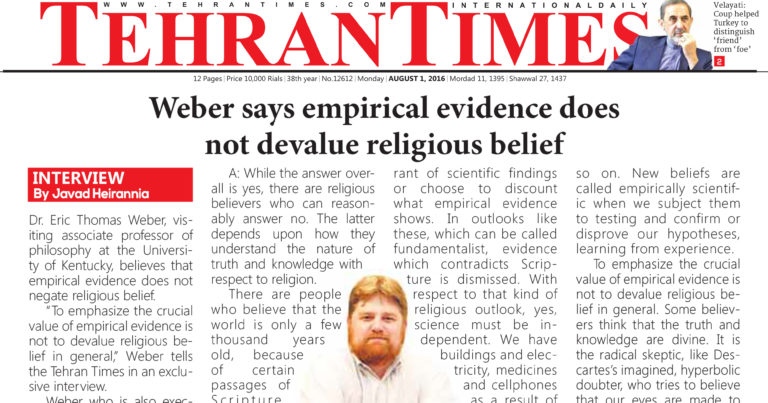
Interview on Science & Religion in The Tehran Times

This piece was originally published on August 1, 2016, pages 1 and 9.

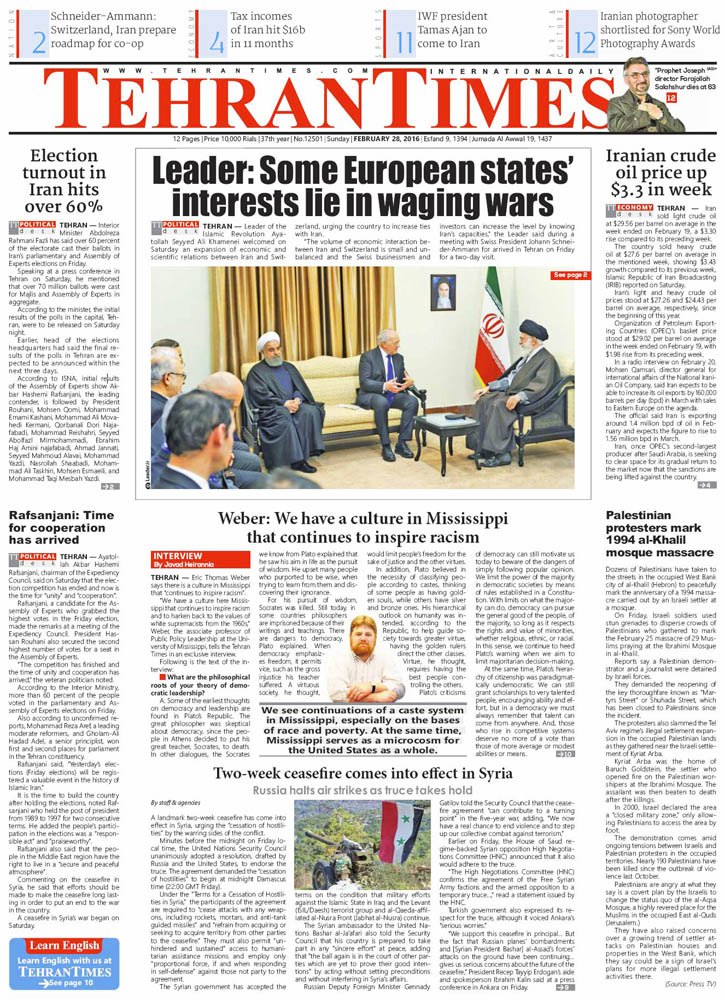
It’s an honor and a pleasure to be interviewed for The Tehran Times. I am especially grateful that the put the very philosophical interview I gave on the front page of the newspaper. The Tehran Times is Iran’s major English language newspaper. I have had the opportunity to talk quite a few times about philosophy and democracy. Here’s photo of the interview, which links to the full Adobe PDF file for the day’s newspaper (August 1st, 2016). My piece is on pages 1 and 9:

This is a photo of a cut out of the front page interview I gave for The Tehran Times on science and religion.

I got a lot of positive feedback about this piece, as well as some interesting comments and questions on Facebook. In case you want to see those, here’s the post – sorry for the repeat image. I’ve not embedded a Facebook post on this site before, so here’s a test:

I’m honored to see my piece on the front page of the Tehran Times again. How cool is that? (See pgs 1 & 9): http://media.mehrnews.com/d/2016/07/31/0/2156798.pdf
Posted by Eric Thomas Weber, author on Sunday, July 31, 2016


If you’ve not yet connected with me on Facebook, “like” my author page, and if you’re a tweeter, following me @EricTWeber.

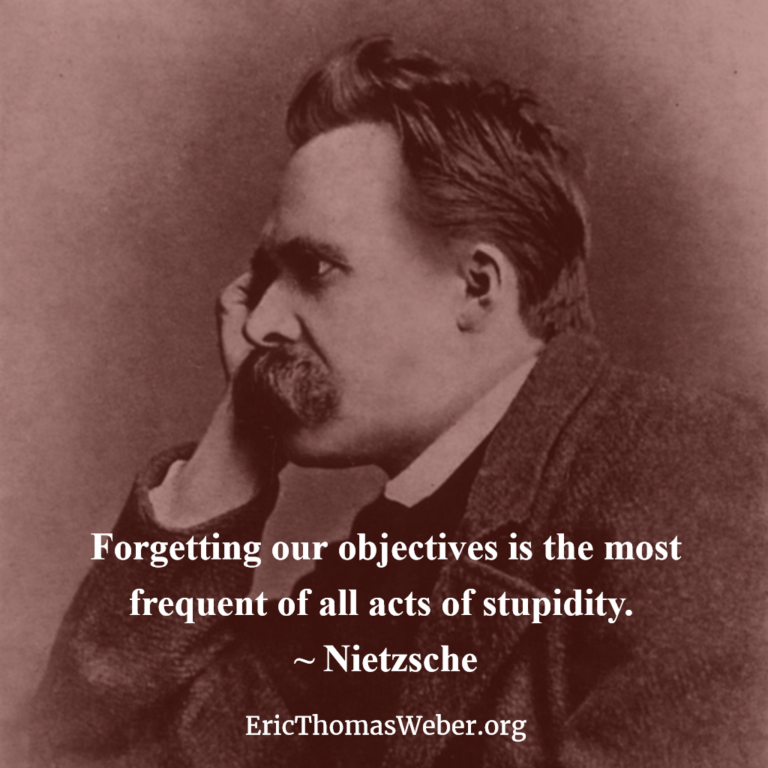
Nietzsche photo with a quote, which reads: "Forgetting our objectives is the most frequent of all acts of stupidity." It also shows the Web address for my Web site, EricThomasWeber.org

I’m planning an op-ed on education, that has to do with how we often focus intensely on some details while forgetting our goal. That reminded me of an often quoted line from Nietzsche. The usual way we see it, it reads: “Forgetting one’s purpose is the commonest forms of stupidity.”

I like that version too, but the scholar in me goes a bit nuts when I can’t actually track down the source of a quote. So, I looked for and found the original version of this in Nietzsche’s Human, All Too Human, volume 2, number 206. The translation in the English version from Oxford is what I included in the photo. To put it in text too, it reads:

“Forgetting our objectives is the most frequent of all acts of stupidity.”

You can check it out for yourself in Google Books.

The Eulogy Virtues Valued in Life

This is a photo of the cover of David Brooks's latest book, The Road to Character, 2015. David Brooks has been challenging young people lately to think about more than what he calls the “résumé virtues.” His latest book is called The Road to Character, and he has been touring the country to talk about what’s more important than the many small steps we take in advancing our careers. Which matters more: what people think or say about your résumé, or what people will say at your funeral?

Brooks argues that so many of us today focus on the wrong things — on getting the next notch in our belts — when what we should be developing are the eulogy virtues. In the end, people usually don’t care about this or that promotion you earned. The bigger house you bought rarely comes up at a funeral. What matters most to people are the qualities of your character, not the quantities in your bank account.

Brooks’s message especially to young professionals and those aspiring to be them resonates with me. First of all, Aristotle noted that happiness is something that can only really be measured in terms of a person’s whole life. When we say we are happy, in everyday language, we are primarily talking about how we feel right now. What makes for a happy life, however, is not a certain number of happy-feeling-moments. We can endure great challenges for the right reasons and be happy about what we have contributed. The feeling is less the issue, however. What matters, as Brooks notes, is our character.

With a focus on professionalism today, one can certainly make a great deal more money going into any number of careers than one earns as a teacher. So some other force pushes people into that line of work. As I said in my last post, I’ve been very fortunate to feel appreciated at the University of Mississippi. Recently, a number of students added to that very kindly.

The funny thing about moving, as Annie and I soon will, is that you get a glimpse of people’s appreciation of the eulogy virtues, but without the dying part.

The logo of the University of Mississippi's Student Alumni Council.The Student Alumni Council at the University of Mississippi is a clever organization, in which current students are involved in the work of the alumni association — hook’em early, they say. It’s a great idea, actually, for networking purposes as well as for opportunities for student leadership. Yes, those are related to résumé virtues. The group is more meaningful than that, however. They organize an event each spring (though I don’t know how long this has been going on) where they recognize mentors, hosting a “Random Acts of Kindness” event. When I received my invitation, I joked to myself that I generally intend my acts of kindness to be thoughtful and purposeful, rather than random.

The event was lovely. One student at a time got up to say a few words about a mentor he or she wanted to recognize on campus with a Random Act of Kindness award. Next, two students got up to say that they had both nominated a certain professor. It was heartwarming. We do this work because we believe in it. It’s icing on the cake when people actually show you appreciation for it. When the time came, I was taken aback by three students who each got up to say some deeply thoughtful and kind things about our work together. I got a taste of the value of the eulogy virtues, without having to die, when Mary Kate Berger, Natalie King, and Rod Bridges each spoke eloquently and kindly in their explanations for their nominations for me.

I feel profoundly fortunate to have worked with great people in Mississippi. I also am more confident that Brooks and Aristotle are right. Character is the most important thing we can cultivate. The funny thing that so many people miss, however, is that attending to one’s own happiness really comes down to attending to the same for others. I can’t think of a more rewarding opportunity than to help others to shape their character.

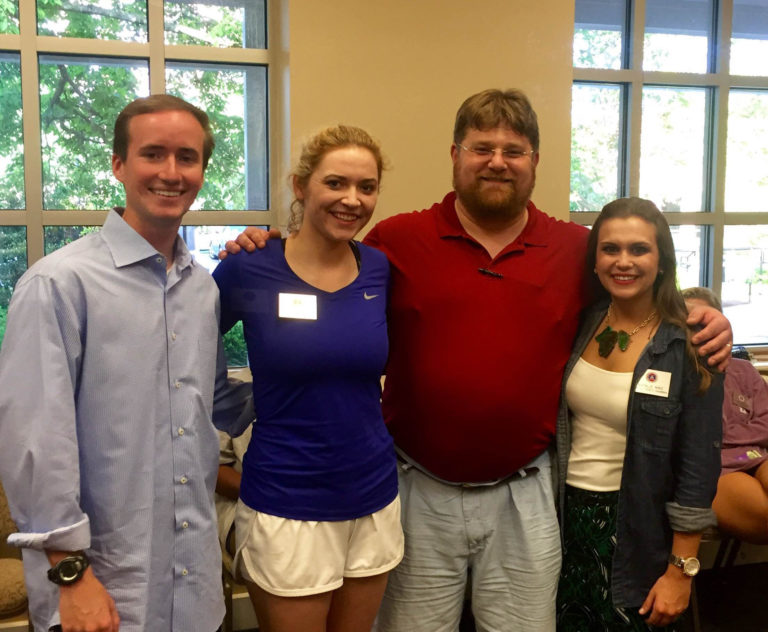
Thank you again, Rod, Mary Kate, and Natalie (left to right in the photo)!

This is a photo of Rod Bridges, Mary Kate Berger, Eric Thomas Weber, and Natalie King at the UM 2016 Student Alumni Council 'Random Acts of Kindness' event.