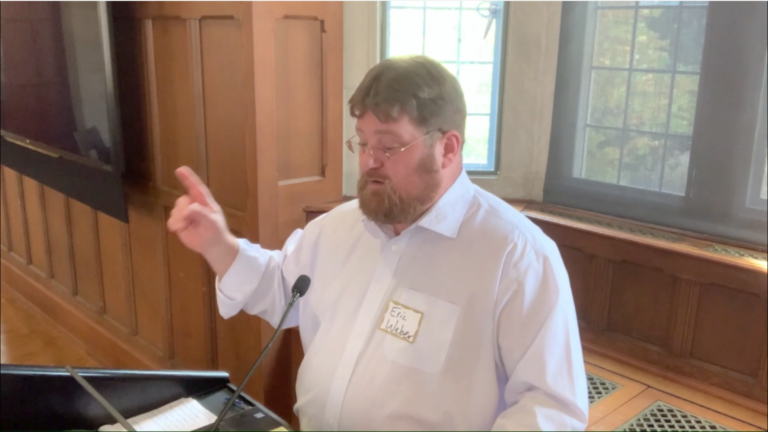
On April 23rd, I will present online on “Fighting for a Culture of Justice in Dark Times” for the Hale Ethics Series at the Rochester Institute of Technology, in Rochester, NY.

Date: April 23, 2026
Time: 11:00 a.m. - 12:15 p.m.
Event: Invited Online Talk for the Hale Ethics Series at the Rochester Institute of Technology
Topic: Fighting for a Culture of Justice in Dark Times
Sponsor: Hale Ethics Series
Venue: Rochester Institute of Technology
Location: Rochester, NY

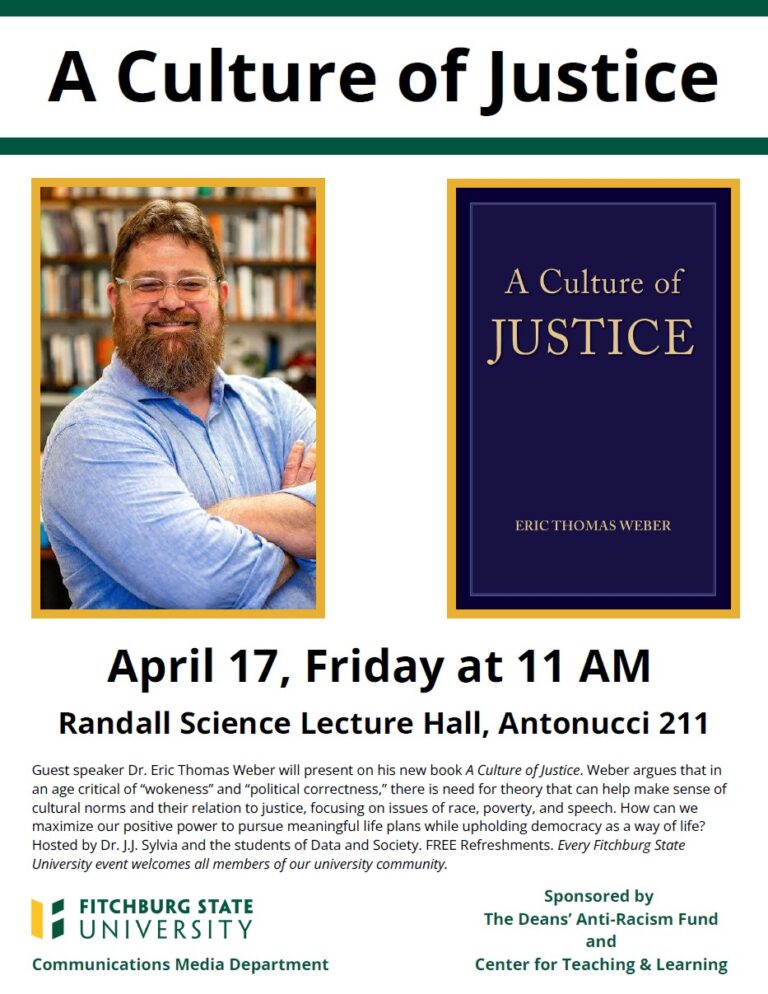
I will be traveling to Fitchburg State University to give a talk in their Anti-Racism Initiative on “A Culture of Justice,” regarding my latest book.

This is a flyer that reads: A Culture of Justice April 17, Friday at 11am, Randall Science Lecture Hall, Antonucci 211. Guest speaker Dr. Eric Thomas Weber will present on his new book A Culture of Justice. Weber argues that in an age critical of “wokeness” and “political correctness,” there is need for theory that can help make sense of cultural norms and their relation to justice, focusing on issues of race, poverty, and speech. How can we maximize our positive power to pursue meaningful life plans while upholding democracy as a way of life? Hosted by Dr. J.J. Sylvia and the students of Data and Society. FREE Refreshments. Every Fitchburg State University event welcomes all members of our university community. Sponsored by The Deans’ Anti-Racism Fund and the Center for Teaching & Learning. Fitchburg State University Communications Media Department

Date: April 17, 2026
Time: 11:00 am
Event: Lecture for the Anti-Racism Initiative at Fitchburg State University
Topic: A Culture of Justice
Sponsor: The Dean's Anti-Racism Fund and the Center for Teaching and Learning, School of Arts and Sciences, Fitchburg State University
Venue: Randall Science Lecture Hall, Antonucci 211
Location: Fitchburg, MA 01420
USA
Public: Public

A discount code is now available for the book for use on the publisher's Web site here. The code is: SNPF26.

Image of the flyer for my talk at Catholic University of America. On April 9th of 2026, I will meet with Dr. William Barbieri, his colleagues, and students, to talk about “A Culture of Justice: Should a University Have a Creed?” a talk about my latest book, A Culture of Justice. If you’d like to join the meeting via Zoom, you can us this link.

Date: April 9, 2026
Time: 02:15 - 3:15 p.m.
Event: Invited Talk on A Culture of Justice, Catholic University of America
Topic: A Culture of Justice: Should a University Have a Creed?
Sponsor: Dr. William Barbieri
Venue: Catholic University of America
Location: McMahon Hall 311
Washington, D.C.
Public: Public

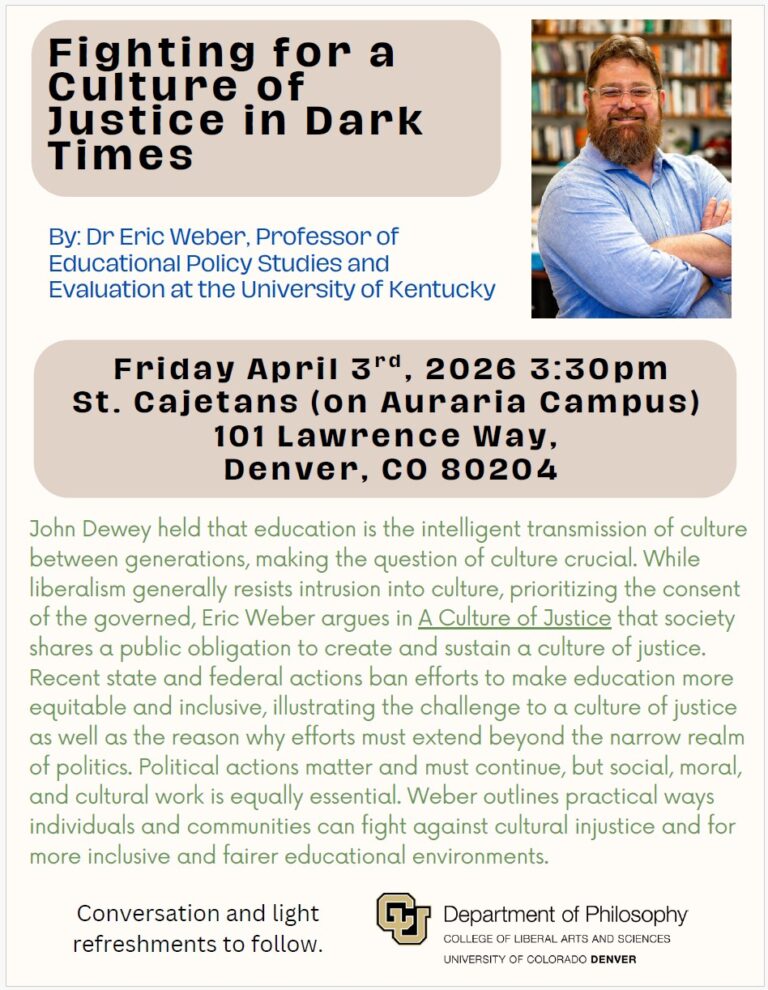
Image of the flyer created for the talk, with a picture of Eric Weber also. I’ll be presenting “Fighting for a Culture of Justice in Dark Times” for the 2026 Honi Haber Memorial Lecture at the University of Colorado Denver on Friday, April 3rd at 3:30 pm.

Abstract

John Dewey held that education is the intelligent transmission of culture between generations, making the question of culture crucial. While liberalism generally resists intrusion into culture, prioritizing the consent of the governed, Eric Weber argues in A Culture of Justice that society shares a public obligation to create and sustain a culture of justice. Recent state and federal actions ban efforts to make education more equitable and inclusive, illustrating the challenge to a culture of justice as well as the reason why efforts must extend beyond the narrow realm of politics. Political actions matter and must continue, but social, moral, and cultural work is equally essential. Weber outlines practical ways individuals and communities can fight against cultural injustice and for more inclusive and fairer educational environments.

Cover for 'A Culture of Justice.'

The link in this image goes to SUNY Press’s page for the book.

For those interested in a copy of A Culture of Justice, the book will be out in paperback for the general public in July of 2026 and I will have a discount code available, which I will share on my social media pages, such as on Facebook, X.com, and LinkedIn.

Date: April 3, 2026
Time: 03:30-05:00 p.m.
Event: 2026 Honi Haber Memorial Lecture @ UC Denver
Topic: Fighting for a Culture of Justice in Dark Times
Venue: St. Cajetans (Auraria Campus)
Location: 101 Lawrence Way
Denver, CO 80204
USA
Cover for 'A Culture of Justice.'

A Culture of Justice (Albany, NY: State University of New York Press, 2026)

Cover for 'A Culture of Justice.'Argues that there is a shared public obligation to establish and maintain a culture of justice, with implications for education, poverty, free speech, and “PC” culture.

Adobe PDF Flyer for the Book

**You can use the discount code: SNPF26 on the publisher’s site to get a 30% discount on the book while the discount lasts. The paperback comes out in July of 2026.**


Description

In A Culture of Justice, Eric Thomas Weber shows how culture can enable or inhibit the pursuit of justice. Weber argues that there is a shared, public obligation to establish and maintain a culture of justice. Culture can be employed to threaten people’s self-respect, to diminish their sense of positive power to pursue meaningful life plans. Weber also addresses problems of poverty and stigmatization as well as of racism and threats conveyed by means of public speech and the cultivation of hatred. Advancing John Dewey’s idea that democracy is a way of life, not merely a set of political mechanisms, he draws implications for policies and practices related to poverty, education, free speech, and the inadequately named set of norms that we call “political correctness.” Written in an accessible style, A Culture of Justice offers numerous everyday examples and conflicts for the reader to consider.

Eric Thomas Weber is Professor and Director of Graduate Studies in Educational Policy Studies and Evaluation at the University of Kentucky and serves as Executive Director of the Society of Philosophers in America (SOPHIA). He is the author and editor of several books, including Uniting Mississippi: Democracy and Leadership in the South.

Also available on AMAZON

Endorsements

Dr. Nicholas Tampio“A pleasure to read, A Culture of Justice will appeal to a wide audience of social and political philosophers, scholars and practitioners of education, and people thinking about racial justice. Weber makes clear the relevance of the great American pragmatists to addressing current social and political problems such as poverty, hate speech, and racism.”

— Nicholas Tampio, Fordham University


Freedom in Education: A Philosophical Critique of Current Educational Policies

Video, 1 hr & 6 mins

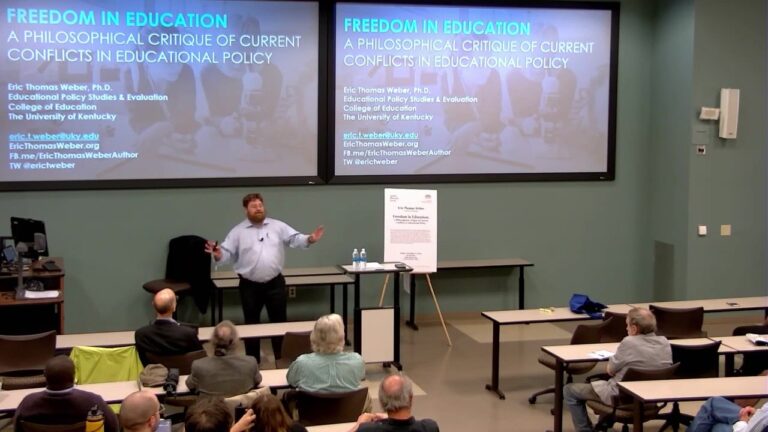
This video is a recording of the presentation I gave in Middle Tennessee State University’s Applied Philosophy Lyceum speakers series on November 17, 2023, in Murfreesboro, TN.

The talk is titled, “Freedom in Education: A Philosophical Critique of Current Educational Policies,” and the abstract for the presentation reads as follows:

Parents and guardians are naturally concerned about what their children are taught in schools. Some lament what they feel is a lack of control over curricula and what are thought to be forces or agendas that they believe are not in kids’ best interests. The arguments advanced in recent conflicts take two main forms. The first, advanced in similar fashion on opposing sides of issues concerning gender and early education, takes the form of arguments to “protect” children. The second, typically arising in discourse about desire for exclusion or selection of curricular messages or content, typically focuses on parents’ rights, in particular, to freedom of choice, whether regarding selection of schools, book banning, or inclusion or exclusion of desired or undesirable subject matters from curricula. In this talk, Dr. Weber will defend the importance of students’ and teachers’ freedom and challenge the overreach of dominant parental views that seek to silence the lived experiences and concerns of marginalized groups.

NOTE: At one point, I accidentally said “Transylvania State University,” which was intended to refer to Transylvania University, which is a private institution. This was an accidental case of misspeaking. The point was to contrast with state institutions, which was on my mind, and probably led me to use that word, “state,” resulting in the opposite of my intended meaning… My mistake!

Philosophical Research Methods: This talk was delivered in fall 2023, when I was teaching a course on Philosophical Research Methods in the University of Kentucky’s College of Education. I mention this because in this talk, I describe my methodology explicitly for the project beginning at minute 14 until minute 19. For those interested in that portion of the talk, you can jump to those minutes.

Photo of Dr. Phil Oliver

Dr. Phil Oliver

Thanks again! I am most grateful to Dr. Phil Oliver for organizing a wonderfully welcoming event, which featured a great turn out on a rainy Friday evening. I’m also grateful to the members of the MTSU department of Philosophy and Religion, as well as to Heather Gibbs, who kindly coordinated the details of my visit.

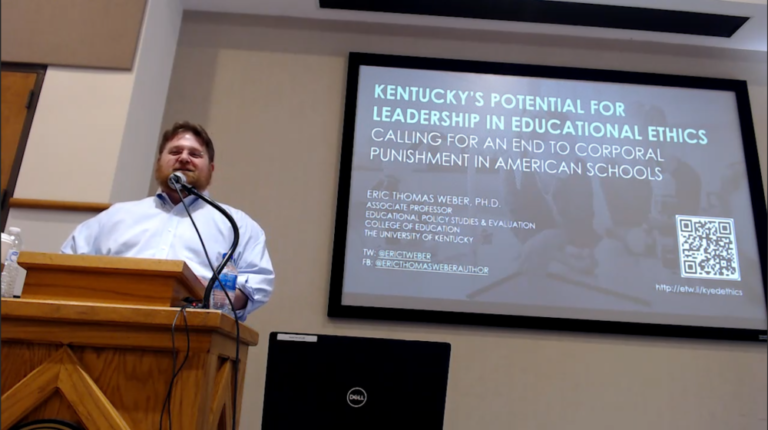
KY’s Potential for Leadership in Educational Ethics: Calling for an End to Corporal Punishment in American Schools

2023 Commonwealth Ethics Lecture at Bellarmine University in Louisville, KY

In the spring of 2023, the Ethics and Social Justice Center at Bellarmine University issued a call for proposals for their yearly Commonwealth Ethics Lecture. They invited scholars from around the state to propose a talk to be delivered for their 2023 lecture, considering approaches from all disciplines and with special interest in interdisciplinary dialogue and topics, encouraging “critical reflection, dialogue, and constructive action on contemporary ethical issues in society.” They also welcomed proposals “related to politics, societal well-being, and individual happiness,” as well as that “intersect these themes with regional issues.”

I pitched my proposal in relation to the fact that Kentucky is a state that continues to permit and make use of corporal punishment in public schools. I have long thought about corporal punishment especially as an example of a practice long outmoded and for which evidence has become increasingly clear that better alternatives are available and that long-term effects of the practice are psychologically and medically discouraged. Given this opportunity, it was a great chance for me to focus on corporal punishment directly, so I jumped at the chance finally to focus extensively on this topic.

Kentucky has decreased the use of the form of discipline in public schools to nearly negligible levels, with 17 recorded instances of corporal punishment in the 2020-2021 school year, which suggests that the practice would not be difficult to end at the state level. Given that, Kentucky could serve as a leader among states that presently permit and engage in the practice, to show how others can follow the lead of the Commonwealth state of Kentucky, to end the practice around the country. The video here above is 1hr and 1 min long, concluding at the end of my talk, not including the question and answer session, though that was fun and rewarding for me also.

I am especially grateful to Dr. Kate Johnson for being a welcoming and great host at Bellarmine University for the talk. The attendance and recording of the talk were great and much appreciated.

The PowerPoint slides for my talk are available online here.

VIDEO: Freedom in Education for Diversity of Flourishing

This video was recorded at Vanderbilt University on October 15th, 2022, at the John and Shirley Lachs Conference on American Philosophy. My presentation was titled “Freedom in Education for Diversity of Flourishing.” Here’s the program for the conference. I am grateful to Vanderbilt University’s Philosophy Department for support for my participation in the conference and for permission to post the video. 

This is a thumbnail image of the conference schedule, with a link to the PDF file. I feel honored to be among the presenters at this important event honoring the incredible contributions of Dr. John Lachs of Vanderbilt University. I will be presenting my paper, “Freedom in Education for Diversity of Flourishing,” on both the incredible importance of freedom in education as well as some of its dangers.

Date: October 14, 2022—October 15, 2022
Event: John and Shirley Lachs Conference on American Philosophy
Topic: "Freedom in Education for Diversity of Flourishing"
Sponsor: Vanderbilt University
Venue: Alumni Hall
Location: Nashville, TN
Public: Public

America’s Public Philosopher: Essays on Social Justice, Economics, Education, and the Future of Democracy (New York: Columbia University Press, 2021)

The title page of "America's Public Philosopher."

Description

John Dewey was America’s greatest public philosopher. A prolific and influential writer for both scholarly and general audiences, he stands out for the remarkable breadth of his contributions. Dewey was a founder of a distinctly American philosophical tradition, pragmatism, and he spoke out widely on the most important questions of his day. He was a progressive thinker whose deep commitment to democracy led him to courageous stances on issues such as war, civil liberties, and racial, class, and gender inequalities.

Cover image of 'America's Public Philosopher'This book gathers the clearest and most powerful of Dewey’s public writings and shows how they continue to speak to the challenges we face today. An introductory essay and short introductions to each of the texts discuss the current relevance and significance of Dewey’s work and legacy. The book includes forty-six essays on topics such as democracy in the United States, political power, education, economic justice, science and society, and philosophy and culture. These essays inspire optimism for the possibility of a more humane public and political culture, in which citizens share in the pursuit of lifelong education through participation in democratic life. America’s Public Philosopher reveals John Dewey as a powerful example for scholars seeking to address a wider audience and a much-needed voice for all readers in search of intellectual and moral leadership.


Endorsements

In these troubled times, Eric Thomas Weber has compiled a magnificent set of essays by John Dewey, the preeminent American public philosopher of the twentieth century. With the help of Weber’s commentaries, all Americans will be able to see how Dewey still speaks to us today, with wisdom and urgency. — Elizabeth Anderson, author of Private Government: How Employers Rule Our Lives (and Why We Don’t Talk about It)

In this collection Eric Weber presents expertly curated essays by one of America’s great public intellectuals. John Dewey’s insights into the core issues of American life, then as now, are as fresh today as when they were first published. They provide ample evidence of his continuing relevance for our exceptional time. — Larry A. Hickman, editor of The Correspondence of John Dewey

John Dewey is the American philosopher of democracy. He understood that democracy, making choices together, is an end in itself, and that attempts to short-circuit democratic processes in the name of something else, whether it’s ethnic nationalism or globalization, diminish us as human beings. His wisdom never goes out of style. There is no better (or worse) time to read him again. — Louis Menand, author of The Metaphysical Club

This is an outstanding collection, unique and most timely, that should receive attention from the sphere of public policy and politics. Weber has chosen writings that speak to America and the world today. — John Robert Shook, coeditor of Dewey’s Enduring Impact: Essays on America’s Philosopher


Reviews

Dr. Nicholas TampioJohn Dewey is on the short list of America’s greatest philosophers. He has changed how many people think about democracy, politics, education, economics, and science. The problem, however, is that many of Dewey’s books are impenetrable for those without time and philosophical training. His book Democracy and Education, for instance, was a textbook that Dewey wrote for his philosophy of education students at Teachers College, Columbia University, and it sometimes can be hard to figure out how the discussion of Plato and Rousseau, for instance, matters for the question of how to educate children here and now. Fortunately, John Dewey wrote lively articles for newspapers and magazines. If Dewey was not the first public intellectual, he was certainly one of the most energetic, publishing hundreds of articles in The New Republic, Atlantic Monthly, and outlets that no longer exist. But how can a newcomer find these articles and make sense of them? — Nichlas Tampio, author of Common Core: National Education Standards and the Threat to Democracy


The logo of Columbia University Press. America’s Public Philosopher was published in January of 2021 with Columbia University Press.