
The Nonsense of Beating Sense into Kids

Eric Thomas Weber, first published September 1, 2015 in The Prindle Post.

The start of another academic year is cause to reflect on the aims of education and the fact that 19 states in the U.S. still use corporal punishment in public schools. Many have yet to learn the counterproductive and harmful effects of disciplining kids with violence. Nowhere is the mistake more troubling than in our public schools.

Image of a paddle in a traditional school classroom.

‘The board of education’ by Wesley Fryer is licensed under CC BY-SA 2.0 (via Flickr)

I have argued elsewhere against school corporal punishment on grounds of the right to security of person and given the Platonic warning that “nothing taught by force stays in the soul.” The aims of education offer a further, crucial reason why we ought to end the use of corporal punishment in public schools.

Photo of John Dewey.What is school for? Somewhere at the heart of the answer should be the idea of educating people to be critical thinkers. John Dewey once argued that such a goal is implicit in the “supreme intellectual obligation.” That obligation calls for empowering all citizens with the scientific attitudes and intellectual habits of mind necessary to appreciate wisdom and to put it to use. Expert scientists must push the envelope of knowledge, but if intellectuals are to benefit humanity, the masses of people need to be sufficiently critical thinkers to benefit from scientific innovations.

Critical thinking involves the development of a skeptical attitude, one which expects or hopes to uncover justification or evidence. It appreciates well-founded authorities, understanding authority as a relationship of trust based on good reasons for it. For schools to cultivate critical thinking in young people, kids need to be comfortable questioning their teachers, administrators, and parents. In public schools, we need safe environments in which intellects are allowed and enabled to experiment, to be creative, and to learn whether and why some authorities are warranted, when they are.

Continue Reading »

“Violence Taught When Corporal Punishment Used”

Originally published in The Clarion Ledger, May 14, 2013, 9A.

The harsh treatment of prisoners in the U.S. causes much controversy, yet in our public schools, institutionalized
violence is commonplace.

This image is shows part of the scan of my 2013 Clarion Ledger article, 'Violence Taught When Corporal Punishment Used.' If you click on this image, you'll be taken to the full scan on my Academia.edu page.

In April, the Hattiesburg American reported that corporal punishment declined in Mississippi schools between 2007 and 2012 from more than 58,000 reported instances to around 39,000.

Continue Reading »

The logo for The Giving Net.Looking forward to an interview with Andrea Price on The Giving Net podcast, based out of Little Rock Arkansas. The Giving Net focuses on civic engagement, philanthropy, and public service. I’ll be talking about my book, Uniting Mississippi.

Date: October 19, 2015
Time: TBD
Appearance: Interview on The Giving Net podcast
Outlet: The Giving Net: Civic Engagement, Philanthropy, Public Service
Location: Little Rock, AR
Format: Podcast

If you'd like me to speak with your group, visit my Speaking page.

The logo for KUAR 89.1 NPR, University of Arkansas Little Rock's Public Radio channel.Looking forward to interviewing on “The Clinton School Presents” radio show on Little Rock’s NPR affiliate, KUAR, 89.1 radio.

Date: October 19, 2015
Time: 1:30-2:00 p.m.
Appearance: Interview on The Clinton School Presents
Outlet: NPR Affiliate in Little Rock, AR
Location: Little Rock, Arkansas
Format: Radio

If you're in town, come to the book signing earlier that day at the Clinton School for Public Service, from 12-1. If you're interested in having me speak with your group, visit my Speaking page.

One University with Great Leadership

At so many colleges and universities, administrators can be checked out and out of touch, or be disaffected pencil pushers. Faculty and their administrators rarely get along well. I am with folks who want to challenge leadership when it’s wrong. At the same time, it’s important to give credit where it is due. On top of that, when there is great leadership, we should recognize it and point it out, especially if we want more of it.

The Lyceum building at the University of Mississippi.

Some fantastic universities can be really poorly run. I recall hearing recently about some foolishness from Emory University’s President. He encouraged compromise in the public sphere with reference to the 3/5ths compromise as his guiding example. It was one of the awful elements of our Constitution. Fortunately, Emory will soon have a new President, who will, I hope, be a bit more thoughtful and wise in his public commentaries.

Continue Reading »

Photos from the book signing at Square Books

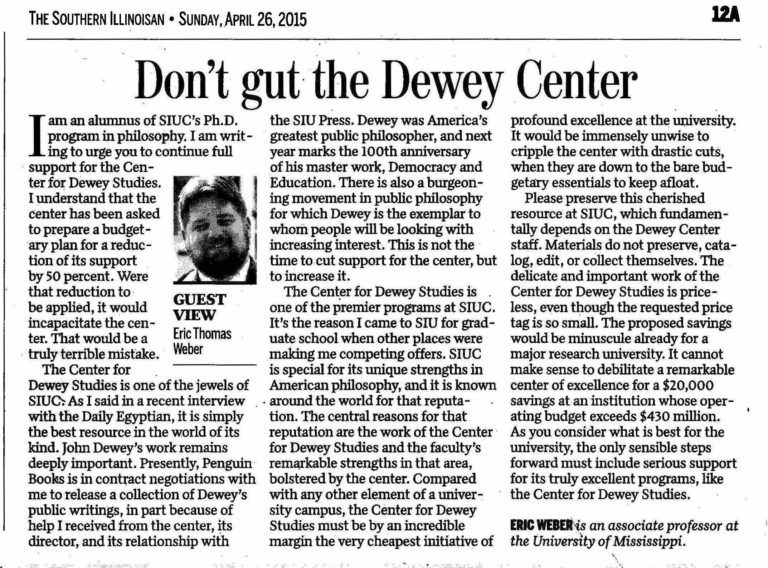
Thanks to Daniel Perea for snapping these pictures at the book signing on Wednesday (September 9th, 2015)! Daniel kindly agreed to let me have the copyright for the images (Weber, 2015). Please do not use these without permission. Visit my contact page and drop me a line if you’d like to use one, especially for press or promotional purposes for future events. Thank you, Daniel!

I also want to thank Cody Morrison and Square Books for being great hosts. It was a wonderful first book signing experience. I’m honored and was very grateful and encouraged to see a number of nice folks brave the weather to hear about Uniting Mississippi. I’m pleased to report that we sold all but two copies, though one of those remaining is now gone. Square Books has one left as I write this, though a new shipment will be there soon. I’ll head over at some point soon to sign those, as one of the really cool things about real, brick and mortar bookstores like Square Books, and about literary towns like Oxford, is that authors sign books here and you can get your new book already signed by the author. You can’t do that on the forest-river-yellow Web site site. Thanks again, Square Books!

To learn more about the book, visit my page for Uniting Mississippi. If you’d like to support local bookstores like Square Books, you can order your copy on their Web site here:

Buy ‘Uniting Mississippi’ from Square Books

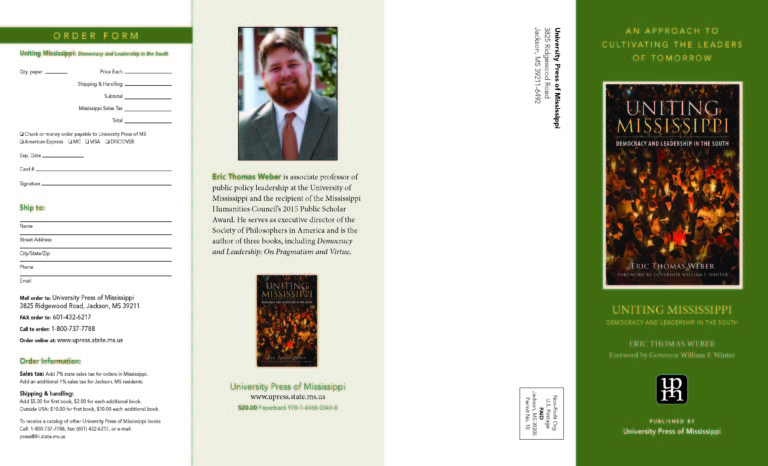
You can also see a brochure about the book here:

Printable Adobe PDF Brochure for ‘Uniting Mississippi’

Photo of Weber signing a book for Mrs. Gray in Oxford, MS.

I’ve got a gallery of photos from that evening, which won’t be found here if you clicked on the “Photos” link in the menu. It has something to do with the kind of post I put the gallery in. Anyway, click here to see all the photos from that night.

Thanks again to Daniel Perea for taking the pictures that night. Please do not reuse these without requesting permission first. Copyright Weber 2015.

Philosophy Lies at the Heart of Mississippi Education Debate

Originally published in The Clarion Ledger, September 6, 2015, 2C

Click here for a full-sized Adobe PDF scan of the artile.

Click for a printable PDF scan.

Mississippians have been entangled in a deep philosophical debate about education funding for months, though attention has focused largely on technical details. Ballot initiative 42 that will be decided this November asks: “Should the state be required to provide for the support of an adequate and efficient system of free public schools?” If voters pass the initiative, they would be demanding an amendment to the state Constitution making that requirement explicit.

This is a photo of the top of the scan of my Clarion Ledger article, 'Philosophy at Heart of Mississippi Education Debate.' If you click on this image, it will open a full-size, printable Adobe PDF scan of the original piece in the paper.

People who want voters to choose “yes” explain that such a requirement should be enforceable in the courts. Without that, a parent would have no recourse when his or her child must attend a chronically underfunded and failing school.

Continue Reading »

“The Nonsense of Beating Sense into Kids: Corporal Punishment in Public Schools”

The Prindle Post
September 1, 2015

Photo of a hand holding a wooden paddle in a school classroom.I’ll post the full article here in a few weeks to archive it on my site. For now, go read it on The Prindle Post. I am impressed with what the folks at Depauw University are up to in Indiana, at their Prindle Institute for Ethics. Their periodical is the new way to publish, without a doubt. Newspapers are great, but those folks starting out on the Web don’t have to worry about how best to transition. They’re more than a blog and don’t have the cumbersome print concerns.

If you’re interested in the issue of corporal punishment in our public schools, check out my 2013 interview with SVT Nyheter, Sweden’s national TV news service. Soon, I’ll post my Clarion Ledger article from earlier that year on the topic. That article was part of what caught the attention of the Swedish TV folks. When I post that article, I’ll update this post with a link.

“Try Charter Schools Experiment Where Others Failing” (2010)

Now that my new site is up, I’m slowly but surely adding to it the pieces I had up on my old site. This was my first op-ed published in The Clarion Ledger, published March 6, 2010, on 9A. I am grateful for permission to republish my pieces here and elsewhere.

Photo of my op-ed in the Clarion Ledger, which links to a PDF of the scan, though the full text is available below on the Web page featuring this image.

Here’s a scan of the piece, though the character recognition in the file didn’t work well. Therefore, I’m posting here the text from the piece.

Try Charter Schools Experiment Where Others Failing

In January, three University of Mississippi undergraduates advocated for charter schools before the Mississippi House Committee on Education out of concern for the crisis of education in the state. The Public Policy Leadership majors, Chelsea Caveny, Cortez Moss, and Alex McLelland, met resistance to partial measures for progress.

Aside from a few vocal opponents, the general response from Republicans in the room was positive and some Democrats were cautiously open to charter schools. The most vocal opponents of charter school legislation worried about the children who stay behind in traditional schools. One representative exclaimed: “Separate but unequal!”

Continue Reading »