
Judge Carlton Reeves of the U.S. District Court of Southern Mississippi
“Mississippi has a tortured past, and it has struggled mightily to reinvent itself and become a New Mississippi.”
This line is from his breathtaking speech delivered at the sentencing for the murder of James Craig Anderson in Jackson, MS. His speech was published on NPR’s Web site here. If you haven’t read it, you should.
My latest Clarion Ledger piece, published December 8, 2015, 8A.
My latest piece in the Clarion Ledger draws on Aristotle’s insights about friendship, which he called acknowledged reciprocal goodwill. We sure need more of that in Mississippi.
Click here or on the Clarion Ledger logo on the right to read the piece on their Web site.
You can also see a scan of the printed piece on Academia.edu.
Originally published in the Oxford Eagle on October 28, 2015. Republished with permission.
Lyndy Berryhill, Oxford Eagle.
I’m grateful to Lyndy Berryhill of The Oxford Eagle, who came to our forum with Judge Reeves. She also kindly gave me permission to republish her piece on my page here. Thanks again to the Mississippi Humanities Council and to the College of Liberal Arts for their support for the event! Thanks to Berryhill for coming and letting people know about the event. There’s so much to be proud of in Mississippi. It’s crucial that we talk about that more often. Here’s her piece:
Judge Carlton Reeves, photo by Lyndy Berryhill of the Oxford Eagle, 2015.
In the wake of racial discussions on campus, the University of Mississippi provided students with a speaker to talk about Mississippi history and racial violence in the state.
District Judge Carlton Reeves has presided over key race and equality cases in Mississippi
U.S. District Judge Carlton Reeves spoke on “Race and Moral Leadership in the U.S. Judicial System.” Tuesday afternoon in Bryant Hall.
“Mississippi has struggled with its past, but it has also struggled to move forward,” Reeves said.
Reeves famously presided over the racially charged murder of James Craig Anderson and later sentenced his murderers to prison. NPR called his speech at the trial “breathtaking” and it garnered Reeves national media attention. During the forum, Reeves talked about the case and how it was important for people to realize what a hate crime is.
Continue Reading »
“Race and Moral Leadership in the U.S. Judicial System,” open forum discussion
“District Judge Carlton Reeves has presided over key race and equality cases in Mississippi.” (NPR) Photo by Jackson State University.
Where: Bryant Hall room 207, University of Mississippi, Oxford, MS
U.S. Judge Carlton Reeves of Mississippi caught national attention with a speech he prepared for the sentencing in a murder trial. The case concerned the racially motivated murder of James Craig Anderson. Reeves’s speech has been called “breathtaking” on NPR.org and has been viewed well over a million times. NPR published a short bio about “The Man Behind the Speech.”
Reeves’s position and leadership are special in part because of his position as a judge. We often think of executives or legislators as leaders. Judges also exercise leadership in their own unique ways and contexts, however. Reeves’s example is also special because of the context of his leadership and the location and circumstances of it. We will have an open forum discussion about “Race and Moral Leadership in the U.S. Judicial System” in Bryant Hall room 207 on Tuesday, October 27th, at 4pm.
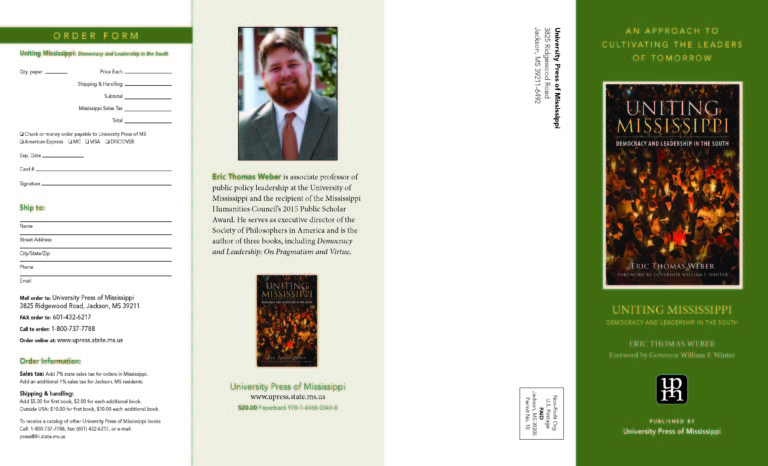
Dr. Eric Thomas Weber, associate professor of Public Policy Leadership at the University of Mississippi, will be moderating the discussion.
This forum is free and open to all students, faculty, staff, and community members. Anyone needing accommodations related to disabilities, contact Dr. Eric Thomas Weber at etweber@olemiss.edu.
or "Governor, Take Down This Flag," in The Clarion Ledger, September 20, 2015, 2C.
My piece, “Mr. Bryant, Take Down the Flag,” came out in The Clarion Ledger this morning. In the printed version, the title is “Governor, Take Down this Flag.” For the next week or two, please head to the electronic version of the piece on the newspaper’s site. You can download and print a PDF of the article by clicking on the image of the printed version.
Originally published in The Clarion Ledger, May 14, 2013, 9A.
The harsh treatment of prisoners in the U.S. causes much controversy, yet in our public schools, institutionalized
violence is commonplace.
In April, the Hattiesburg American reported that corporal punishment declined in Mississippi schools between 2007 and 2012 from more than 58,000 reported instances to around 39,000.
Steve Earle & the Dukes, in collaboration with the Southern Poverty Law Center, have written & released a beautiful and moving song telling Mississippi “It’s Time.” Beyond writing a great tune, Earle has also done something he’d probably be too humble to admit. Through a work of art, he has contributed to moral leadership. He has creatively called Mississippi officials to change a policy. He leans heavily and justifiably on a number of Southern and Mississippi values. He’s right. Mr. Earle & the Dukes, thank you.
I’m working on a book called A Culture of Justice. It’s about the cultural conditions necessary for justice. It’s also about the cultural forces that can lead to oppression and its maintenance or to justice and its preservation. When journalists started reporting to the world with photos of the injustices in the American South, southerners were shamed. The rest of the world was also appalled and demanded change and the observance of the law.
When it comes to Mississippi, some folks are right when they say that just changing a flag alone won’t change much. However, the things that need to change are impeded by attitudes and moral injuries that prevent progress. I wrote elsewhere about “What a Flag Has to Do with Justice.” In short, it can do harm, even if indirectly or in a roundabout way, in its contribution to the maintenance of an unjust culture.
The wonderful thing about culture and its artifacts, however, is that they also include solutions. Earle’s song is a great example of a way to show pride in one’s family and home, while recognizing the mistakes from society’s past. The song is complex. It weaves in norms and sounds that many Mississippians love, even if they were painful in their own ways too. To understand Earle, you have to recognize that he’s trying to reach people in Mississippi and wants reasonably to be proud of what we should be and not of what he shouldn’t be.
I find the video moving and brilliant. I hope you’ll share it widely and tell our public officials: “it’s time.”
Mississippians have been entangled in a deep philosophical debate about education funding for months, though attention has focused largely on technical details. Ballot initiative 42 that will be decided this November asks: “Should the state be required to provide for the support of an adequate and efficient system of free public schools?” If voters pass the initiative, they would be demanding an amendment to the state Constitution making that requirement explicit.
People who want voters to choose “yes” explain that such a requirement should be enforceable in the courts. Without that, a parent would have no recourse when his or her child must attend a chronically underfunded and failing school.
This week, while my Philosophy of Leadership class has been covering Plato’s Republic& the story of Gyges’s ring, I was presented with a Twitter-style version of the story. In the Republic, Plato’s Socrates is talking with people about justice. People only act justly if they can’t get away with injustice, say Socrates’s friends. Well, in today’s world, it turns out that if you can get away with breaking the rules, you can get a lot of Twitter followers quickly. Some high profile people break those rules and get away with it. And, some don’t get away with it.
I am convinced of the need for more public philosophy and feel compelled to contribute as best I can. I’d like to reach more people with the messages that I think need to be said and heard. Apparently you can reach more folks and more will follow you if you first pay a service to generate 10,000 fake followers for you over a few weeks’ time. Why? People with lots of followers are more likely to get followed in return. They’re also more likely to be proposed to other people as good candidates for following, speeding the cycle. What’s the catch? It goes against Twitter policy to pay for fake activity, including following or posting.
Continue Reading »
“You know you’re doing things right when unreasonable people don’t want you around. #PublicPhilosophy”