This photo was taken in 2010, during a class meeting of the spring semester honors writing course in the University of Mississippi’s Sally McDonnell Barksdale Honors College. The photo was taken out on a beautiful day in the Grove.
Photo by Blake Belcher. Copyright Weber 2010.
Gluttony cartoon
If people treated gluttony like they treat some other sins, they’d tell me “No, you may not have fries with that!”
The economy in the U.S. would really take a hit too, I’d wager.
Cartoon by Kevin Frank, from May 28, 2015. Visit KevinFrank.net to check out his work. This particular cartoon is on his site here. I’m grateful to Kevin for permission to post his artwork. He’s a nice fellow.
While on Kevin’s site, I ordered a copy of his book, True North, which I’m looking forward to enjoying. Check it out.
On returning home from Germany, I was startled to hear a voicemail from a white supremacist campaigning for President. It repeated the old trope that there is a genocide being perpetrated on the white race. In the United States, we often throw around words like “Nazi” and “genocide.” Seinfeld’s funny “Soup Nazi” story is one thing, but ridiculous demonizing of political opposition is another. The Iowa Tea Party offered one blatant example, but so do national commentators warning of “liberal fascism” or labeling conservatives “Nazis.” We should sober up and remember what real genocide looks like.
Some of the ovens made to dispose of bodies at the Dachau concentration camp.
In Democracy and Leadership, one of the key virtues of democratic leadership I wrote about is moderation. Today people so often dismiss moderation, seeing it as a weakness of will, as a lack of principled character. I find that view tragic, as it inspires such polarization that even the Federal government was shut down in 2013, despite the fact that the world is watching and the credit rating for U.S. debt was downgraded in 2011. Unstable societies are risky investments, as are unjust societies.
One of the remarkable things rarely considered among average museum-goers is the somewhat unbelievable fact that nations in the Western world have gone to places like Egypt and taken out of sacred and historical landmarks beautiful cultural treasures. It is true that archaeologists get permits. It is true that the explorer who found Tutankhamun’s tomb spent the better part of a decade looking. It is true that he secured and invested somewhat incredible financial resources to have upwards of 100 people helping him to dig and to search for years. There was enormous work that went into finding Tut’s tomb. Nevertheless, I can’t help but appreciate the point of view which says that relevant artifacts belong to the people and region from which they came.
Of course, I also appreciate the view which says that the labor one puts into a work makes it partly yours. Tut’s tomb may have remained lost to this day without the investment of time and money that helped find it. The issue would be less troubling for me if Egypt were not a quite poor country, compared with the U.K., and had the U.K. not had troubling colonialist practices of domination and exploitation.
I’ll write more about this soon. I’m still processing what we saw there. It was harshly jarring for my sense of what human beings are capable of doing – not one or a few troubling individuals, but a coordinated secret police force. Truly sobering. The experience was visceral.
The gate door to the camp reads “Arbeit Macht Frei,” which translates as “Works makes one free,” or “work makes you free.” The message was a horrible lie, as were the fake shower heads in the gas chamber there. More on that in a follow-up post.
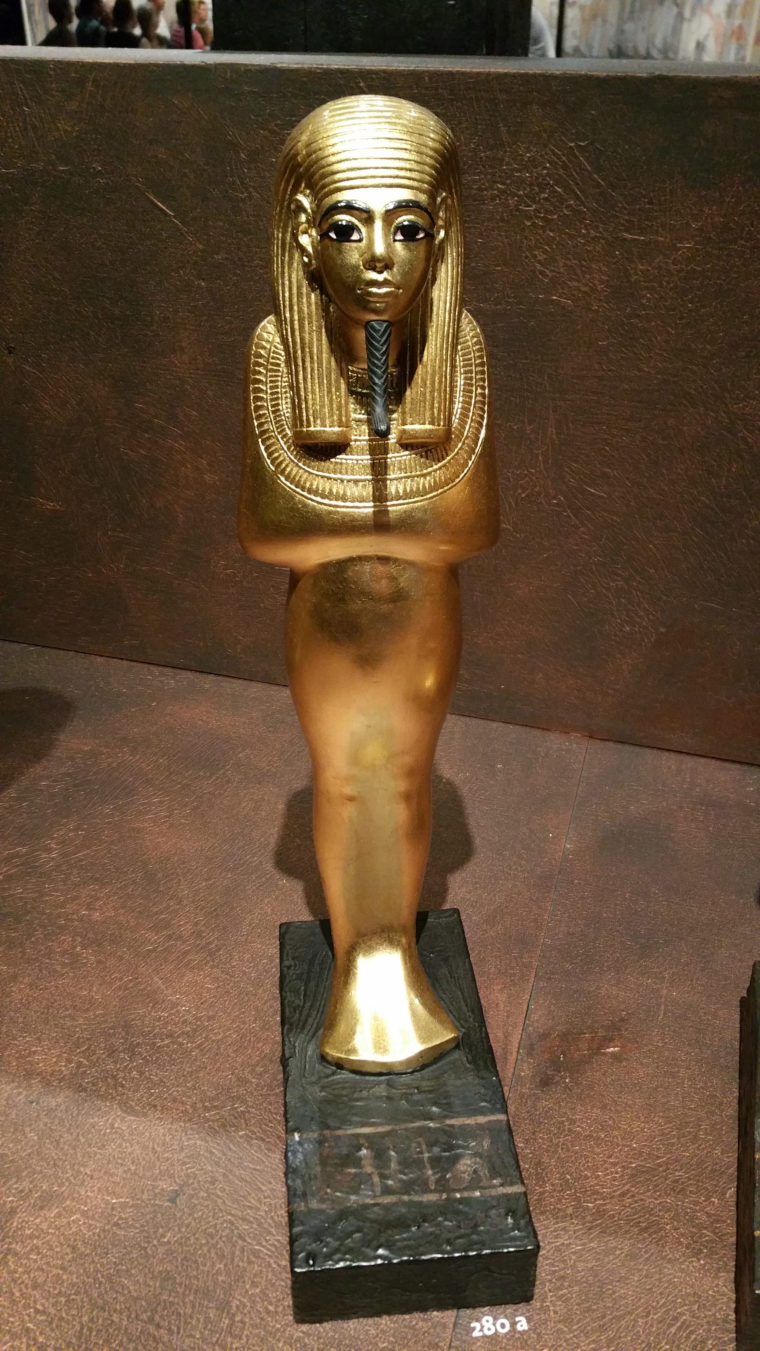
It is easy today to find examples of things that are simply marvels of human invention and brilliance. The everyday cellphone today is a pretty amazing instrument, considering all that one can do. This past week, I had a chance to see an exhibit of replicas of the items that were found in the tomb of Tutankhamun.
What I find remarkable are the incredible effort, skill, and resources that were put into respecting Tutankhamun. At so early a period in history, people gathered and used a simply massive quantity of gold, masterfully designed and adorned, to pay homage to a ruler who died quite young, Tutankhamun. Tut’s tomb featured countless treasures (ok, there were a little over 700), besides the multiple nested shrines, each of which protected yet another shrine of gold-leaf covered wood. Ultimately, inside the larger gold-covered shrines there was an incredible whole piece of carved alabaster, which contained several solid gold nested sarcophagi.
Continue Reading »
No State is permanently safe except on a foundation of justice. And justice cannot be fundamentally in contradiction with the essence of democracy.
James Tufts, John Dewey Ethics
(Carbondale, IL : Southern Illinois University Press, 1908 / 2008)
In August of 2013, I participated in an interview with Swedish National TV News service, SVT Nyheter, on the subject of corporal punishment in Mississippi schools. If you click on the video here above, you’ll see their piece from the start. You can also jump to my interview, 2 min’s in(the rest of the piece is in Swedish). SVT’s news article is online in Swedish here. I’ve made an imperfect Google Translate version in English, which you can open as a PDF file here.
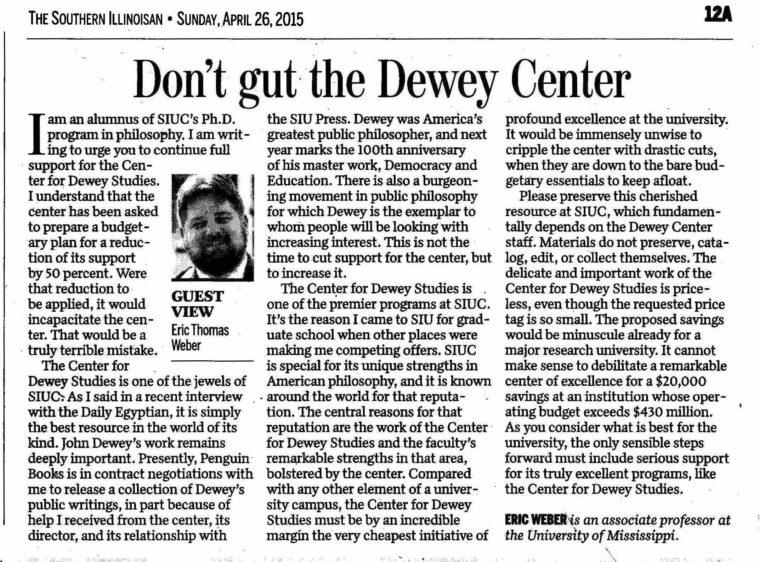
I am an alumnus of SIUC’s Ph.D. program in philosophy. I am writing to urge you to continue full support for the Center for Dewey Studies. I understand that the center has been asked to prepare a budgetary plan for a reduction of its support by 50 percent. Were that reduction to be applied, it would incapacitate the center. That would be a truly terrible mistake.
The Center for Dewey Studies is one of the jewels of SIUC. As I said in a recent interview with the Daily Egyptian, it is simply the best resource in the world of its kind. John Dewey’s work remains deeply important. Presently, Penguin Books is in contract negotiations with me to release a collection of Dewey’s public writings, in part because of help I received from the center, its director, and its relationship with the SIU Press. Dewey was America’s greatest public philosopher, and next year marks the 100th anniversary of his master work, Democracy and Education. There is also a burgeoning movement in public philosophy for which Dewey is the exemplar to whom people will be looking with increasing interest. This is not the time to cut support for the center, but to increase it.
Continue Reading »
I have had some pretty remarkable experiences at the University of Mississippi, as well as some wonderful students to work with (Yes, I end sometimes with a preposition). It’s deeply meaningful to see one’s students so honored and successful.