(Larger) In June of 2015, I met with a group of Grisham Scholars, visiting from Dallas, TX.
The group was from Dallas’s ‘s Uplift Education charter schools. We met in Bryant Hall, where we talked a little bit about my field, philosophy. I explained the major branches of philosophy, and then we talked about how practical philosophy is or can be. To illustrate that, we covered a controversial case in medical ethics, concerning euthanasia. The young men and women were very bright and a lot of fun to engage in discussion.
Rorty, Rawls, and Dewey on Culture’s Role in Justice
This piece, published in 2014, represents an important early step in a book project in progress, titled A Culture of Justice.
Abstract
In this essay, I review the writings of three philosophers whose work con-verges on the insight that we must attend to and reconstruct culture for the sake of justice. John Rawls, John Dewey, and Richard Rorty help show some of the ways in which culture can enable or undermine the pursuit of justice. They also offer resources for identifying tools for addressing the cultural impediments to justice. I reveal insights and challenges in Rawls’s philosophy as well as tools and solutions for building on and addressing them in Dewey’sand Rorty’s philosophy.
This episode focuses on challenges for live and work that concern uncertainty and fear of the unknown. Philosophical ideas about the nature of knowledge can be of help, as well as some conceptual and practical tools for addressing or overcoming our worries.
This new site has tons of social media networking tools, and will make it easy for me to share videos and other new media, like podcasts, etc., on the Web quickly and easily. Check it all out and let me know what you think.
I’ll be posting new stuff as usual, as well as getting some of my past work up on this new site too. Share it with your friends and send me any ideas or thoughts you have about issues that we need to talk more about. Thanks for coming to visit.
Spread the word!
(See the “share bar” links above)
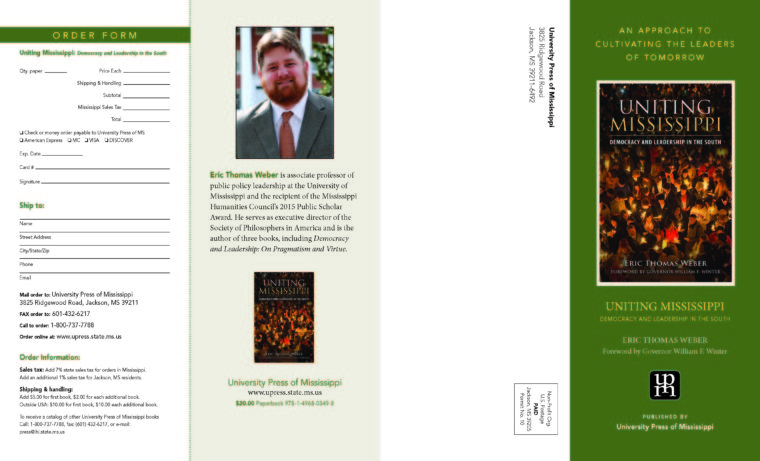
Check out the nice brochure that the University Press of Mississippi designed for Uniting Mississippi. Here’s the printable, two-sided PDF file:
Extended version of ESPN’s 2010 Ole Miss Star Wars commercial
I’m finally getting around to posting videos that I’ve done or been in. This one is mainly cute, not a contribution to public philosophy…
It was fun to do. I come in around 3 minutes in, for the extended version of the ad, but my soundbite didn’t make the shorter version that aired on TV.
This commercial was of interest to ESPN, as they were covering the issue of sports fandom. At the University of Mississippi, we had not had a mascot for years, since the prior one was removed from the field, given his allusion to the plantation-owning Colonel in the Rebel army.
2013 Philosophy Born of Struggle conference, Purdue University, West Lafayette, IN
This is the video of a short talk I gave at the 2013 Philosophy Born of Struggle conference at Purdue University in West LaFayette, IN. The talk is called “On Culture and Self-Respect,” and it represents an early stage in the development of my book in progress, called A Culture of Justice. I got some invaluable feedback at that conference that has helped to sharpen my thesis for this paper and for the book.
If you’re interested in having me come speak with your group, visit my Speaking page.
In July 2015, University of Mississippi graduate, Adebanke Alabi invited me to comment on race and the Church for a series on her blog. The following is my piece, originally published on her page and reposted here with permission.
Mississippi is still home to obstinate racism, even while in 2014 Gallup found it to be the most religious state in the United States. The vast majority of the 44 failing school districts’ enrollments in the state are majority- to almost totally made up of African American students. Some districts have been accused of not having desegregated. We have seen symbolic racism at the University of Mississippi, as well as troubling direct confrontations. Some young people planned and executed a racially motivated murder a few years ago in Jackson, MS.
Despite all of these disturbing cases of racism in Mississippi, many citizens and public officials continue to resist change even to symbols of racism. I have argued that falsely romanticizing heritage does us harm and that symbols, like the Confederate Battle Flag featured in the canton of MS’s state flag, contribute to the perpetuation of racism and injustice. What has gotten very little attention is the tragic inconsistency between the religious beliefs people say that they hold dear and the contradictory behaviors that we see here in Mississippi.
Eric Thomas Weber, first published July 8, 2015 in The Prindle Post.
The June 2015 murders in Charleston, South Carolina, have prompted a remarkable cultural shift in the American South. States around the region are removing or are voting to remove Confederate symbols of various kinds from public spaces. South Carolina and Alabama have made significant moves, and in Mississippi, the Speaker of the House and both U.S. Senators have called for changing the state flag, which presently features the Confederate Battle Flag.
I have argued recently that some heritage can do harm and that denying that Mississippi’s secession had to do with slavery is ignorance, not love, of heritage. For those who acknowledge our troubled history, an important question remains: Why is there such a push to get rid of the flag all of a sudden? What does it have to do with the Charleston murders or justice?
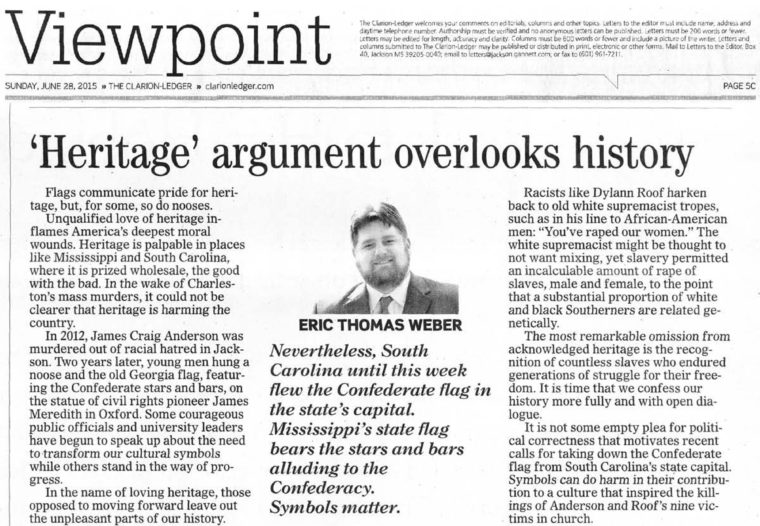
Eric Thomas Weber, first published in The Clarion Ledger on June 27, 2015, 5C.
This article was published online with the title “Sometimes Heritage Does Harm,” and in print, with the title “‘Heritage’ Argument Overlooks History.” It is republished here with permission. Click on the image or here to open a scan of the printed version, or here for a PDF of the online version. The text from the online version is included here below.
Flags communicate pride for heritage, but, for some, so do nooses.
Unqualified love of heritage inflames America’s deepest moral wounds. Heritage is palpable in places like Mississippi and South Carolina, where it is prized wholesale, the good with the bad. In the wake of Charleston’s mass murders, it could not be clearer that heritage is harming the country.
In 2012, James Craig Anderson was murdered out of racial hatred in Jackson,. Two years later, young men hung a noose and the old Georgia flag, featuring the Confederate stars and bars, on the statue of civil rights pioneer James Meredith in Oxford. Some courageous public officials and university leaders have begun to speak up about the need to transform our cultural symbols, while others stand in the way of progress.
In the name of loving heritage, those opposed to moving forward leave out the unpleasant parts of our history. Mississippi and South Carolina were among the states most honest about their defense of slavery in their justifications for secession. Nevertheless, South Carolina until this week flew the Confederate flag in the state’s capital. Mississippi’s state flag bears the stars and bars alluding to the Confederacy.








iTunes has it updated there too, though for some reason presently out of order. I’ll look into that.
“Coping with Uncertainty”
This episode focuses on challenges for live and work that concern uncertainty and fear of the unknown. Philosophical ideas about the nature of knowledge can be of help, as well as some conceptual and practical tools for addressing or overcoming our worries.
The transcript for the episode is here.
If you haven’t already, check out the first two episodes of Philosophy Bakes Bread on the podcast site.
Finally, if you’d prefer to “watch” the podcast on YouTube, here it is:
If you prefer that format, here’s a playlist of the podcast episodes on my YouTube channel.