This piece is the culmination of years of researching and thinking about public philosophy. If you know me, you know that “America’s Public Philosopher” was John Dewey. Elements of this piece will show up in my introduction for a collection of Dewey’s public writings that I am finishing up.
Abstract
This article argues for a definition of public philosophy inspired by John Dewey’s understanding of the “supreme intellectual obligation.” The first section examines five strong reasons why more public philosophy is needed and why the growing movement in public philosophy should be encouraged. The second section begins with a review of common understandings of public philosophy as well as some initial challenges that call for widening our conception of the practice. Then, it applies Dewey’s argument in “The Supreme Intellectual Obligation” to public philosophy, which must not be seen simply as a one-way street from intellectuals to the masses but, rather, as the task of fostering the scientific attitude and intellectual habits of mind in all citizens.
This is the beautiful work of art that the Mississippi Humanities Council commissioned to serve as a plaque for the 2015 Humanities Scholar Award I was honored to receive in February. The event and the honor were deeply meaningful and encouraging.
“There have been 204 mass shootings — and 204 days — in 2015 so far http://wapo.st/1HP45N2”
Receiving the 2012 Thomas F. Frist Student Service Award
It was an honor to have been chosen for the 2012 Thomas F. Frist Student Service Award at the University of Mississippi. PPL graduate Kaylen Addison snapped this great photo of the moment when I was up at the podium to receive the award.
The next pic is the plaque, featuring the university’s colors.
I also got a photo with then-Chancellor Dan Jones, who has been highly encouraging and supportive. In fact, he wrote one of the endorsements for Uniting Mississippi.
Believe it or not, I follow the advice in this video every day. It’s brilliantly simple. It’s also serious. If each of us were really to make a little effort of this kind, the impact would be enormous. It saves on paper use, which cuts down on costs, and it slows the growth of landfills, one hand-washing at a time.
Get comfortable with criticism
A professor from my undergraduate years gave me some of the most important advice I’ve ever received for a career in academia. First, he asked me: “How are you at taking criticism?”
With a bit of a shrug, I said “Ok, I suppose.”
He then explained that “If you can take criticism well, you can go very far.”
He could not be more right. Nonsense criticism needs to bounce off and be forgotten quickly, but most criticisms have substance to learn from. Criticism is a vital means by which we learn and improve. If one can come to want criticism, at least the useful kind, which has some truth to it, then one will continually grow in one’s craft.
Good people won’t be willing to rule for the sake of either money or honor… Now, the greatest punishment, if one isn’t willing to rule, is to be ruled by someone worse than oneself. And I think that it’s fear of this that makes decent people rule when they do.
Plato Republic
(Indianapolis, IN: Hackett Classics, 2004), Book I, 347b–c.
“The Law and Morality”
by Cherita Brown, Richard Gershon, and Eric Thomas Weber
This is the interview I gave Cherita Brown of Mississippi Public Broadcasting, MS’s NPR affiliate, and Professor Richard Gershon of the University of Mississippi School of Law on the relationship between the law and morality. Cherita also interviewed me about my forthcoming book, Uniting Mississippi: Democracy and Leadership in the South.
I hope to joint them again soon, as I had a great time. This is just one example of the collaborations I’ve enjoyed with the School of Law at the university, now that I’m an affiliate faculty member there.
Presentation:
“A Culture of Support and Merit: Promoting Independence without Stigmatizing Dependency”
Abstract:
In ACultureof Justice, I argue that a society has a shared, public obligation to foster self-respect anda sense of positive power in all people. Libertarians like Robert Nozick deny that there is a shared obligation to provide people the means to develop and exercise their self-respect, such as free and reduced lunch programs. While the libertarian is right to value the cultivation of independence, he is wrong, I argue, to stigmatize people who must depend upon government support. I propose a way to advance acultureofsupportandmerit, promoting independence without stigmatizing dependency.


 This piece is the culmination of years of researching and thinking about public philosophy. If you know me, you know that “America’s Public Philosopher” was John Dewey. Elements of this piece will show up in my introduction for a collection of Dewey’s public writings that I am finishing up.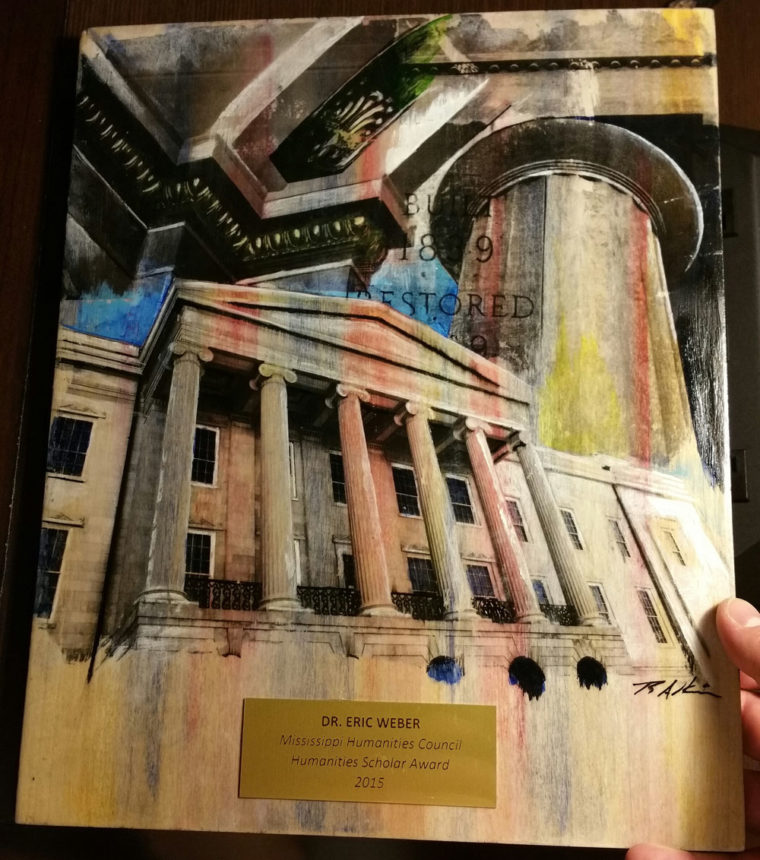


This is the interview I gave Cherita Brown of Mississippi Public Broadcasting, MS’s NPR affiliate, and Professor Richard Gershon of the University of Mississippi School of Law on the relationship between the law and morality. Cherita also interviewed me about my forthcoming book, Uniting Mississippi: Democracy and Leadership in the South.
I hope to joint them again soon, as I had a great time. This is just one example of the collaborations I’ve enjoyed with the School of Law at the university, now that I’m an affiliate faculty member there.