
Marveling at Human Potential, Part 2

One of the remarkable things rarely considered among average museum-goers is the somewhat unbelievable fact that nations in the Western world have gone to places like Egypt and taken out of sacred and historical landmarks beautiful cultural treasures. It is true that archaeologists get permits. It is true that the explorer who found Tutankhamun’s tomb spent the better part of a decade looking. It is true that he secured and invested somewhat incredible financial resources to have upwards of 100 people helping him to dig and to search for years. There was enormous work that went into finding Tut’s tomb. Nevertheless, I can’t help but appreciate the point of view which says that relevant artifacts belong to the people and region from which they came.

Reproduction statue from an exhibit on the tomb of Tutankhamun.

Of course, I also appreciate the view which says that the labor one puts into a work makes it partly yours. Tut’s tomb may have remained lost to this day without the investment of time and money that helped find it. The issue would be less troubling for me if Egypt were not a quite poor country, compared with the U.K., and had the U.K. not had troubling colonialist practices of domination and exploitation.

Continue Reading »

Processing Our Dachau Concentration Camp Visit

I’ll write more about this soon. I’m still processing what we saw there. It was harshly jarring for my sense of what human beings are capable of doing – not one or a few troubling individuals, but a coordinated secret police force. Truly sobering. The experience was visceral.

The gate door to the camp reads “Arbeit Macht Frei,” which translates as “Works makes one free,” or “work makes you free.” The message was a horrible lie, as were the fake shower heads in the gas chamber there. More on that in a follow-up post.

Continue Reading »

Marveling at Human Potential, Part 1

It is easy today to find examples of things that are simply marvels of human invention and brilliance. The everyday cellphone today is a pretty amazing instrument, considering all that one can do. This past week, I had a chance to see an exhibit of replicas of the items that were found in the tomb of Tutankhamun.

A replica of the death mask of Tutankhamun.

What I find remarkable are the incredible effort, skill, and resources that were put into respecting Tutankhamun. At so early a period in history, people gathered and used a simply massive quantity of gold, masterfully designed and adorned, to pay homage to a ruler who died quite young, Tutankhamun. Tut’s tomb featured countless treasures (ok, there were a little over 700), besides the multiple nested shrines, each of which protected yet another shrine of gold-leaf covered wood. Ultimately, inside the larger gold-covered shrines there was an incredible whole piece of carved alabaster, which contained several solid gold nested sarcophagi.

Continue Reading »

In August of 2013, I participated in an interview with Swedish National TV News service, SVT Nyheter, on the subject of corporal punishment in Mississippi schools. If you click on the video here above, you’ll see their piece from the start. You can also jump to my interview, 2 min’s in (the rest of the piece is in Swedish). SVT’s news article is online in Swedish here. I’ve made an imperfect Google Translate version in English, which you can open as a PDF file here.


Guest View: Don’t gut the Dewey Center

Eric Thomas Weber, first published in The Southern Illinoisan, April 26, 2015, 12A.

I am an alumnus of SIUC’s Ph.D. program in philosophy. I am writing to urge you to continue full support for the Center for Dewey Studies. I understand that the center has been asked to prepare a budgetary plan for a reduction of its support by 50 percent. Were that reduction to be applied, it would incapacitate the center. That would be a truly terrible mistake.

This is the scan of my op-ed in The Southern Illinoisan, titled 'Don't Gut the Dewey Center.'

The Center for Dewey Studies is one of the jewels of SIUC. As I said in a recent interview with the Daily Egyptian, it is simply the best resource in the world of its kind. John Dewey’s work remains deeply important. Presently, Penguin Books is in contract negotiations with me to release a collection of Dewey’s public writings, in part because of help I received from the center, its director, and its relationship with the SIU Press. Dewey was America’s greatest public philosopher, and next year marks the 100th anniversary of his master work, Democracy and Education. There is also a burgeoning movement in public philosophy for which Dewey is the exemplar to whom people will be looking with increasing interest. This is not the time to cut support for the center, but to increase it.

Continue Reading »

Photo of Taylor McGraw being congratulated by Dean Doug Sullivan-Gonzalez and Nobel Laureate Elie Wiesel, 2010.

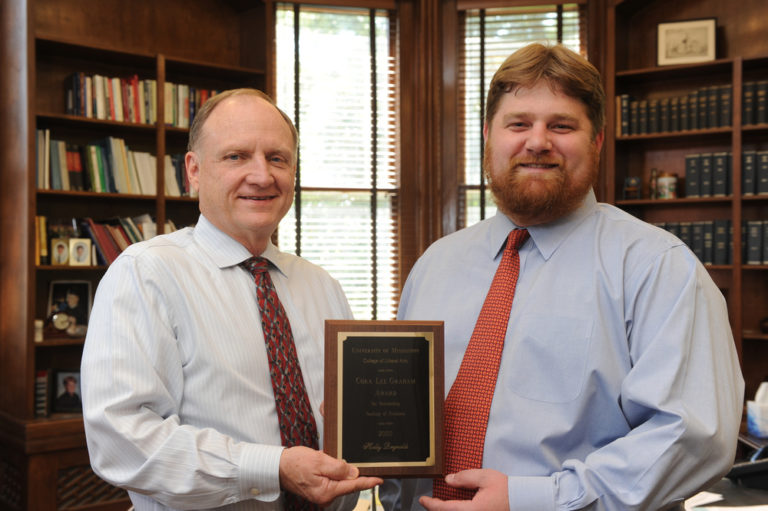
I have had some pretty remarkable experiences at the University of Mississippi, as well as some wonderful students to work with (Yes, I end sometimes with a preposition). It’s deeply meaningful to see one’s students so honored and successful.

June 2015 meeting with Grisham Scholars, visiting from Dallas, TX's Uplift Education charter schools.

The group was from Dallas’s ‘s Uplift Education charter schools. We met in Bryant Hall, where we talked a little bit about my field, philosophy. I explained the major branches of philosophy, and then we talked about how practical philosophy is or can be. To illustrate that, we covered a controversial case in medical ethics, concerning euthanasia. The young men and women were very bright and a lot of fun to engage in discussion.

“‘Coping with Uncertainty,’ Ep3 of Philosophy Bakes Bread”
by Eric Thomas Weber

Sorry, listening to the audio on this website requires Flash support in your browser. You can try playing the MP3 file directly by clicking here.

Philosophy Bakes Bread
Friday, July 31, 2015

PBB-Logo-1-itunesEpisode 3 of Philosophy Bakes Bread is out! It’s called “Coping with Uncertainty.” You can listen to it here, visit the podcast site’s page for the episode, or subscribe to the podcast’s RSS feed here. Or, you can also download it to listen to it later.

iTunes has it updated there too, though for some reason presently out of order. I’ll look into that.

“Coping with Uncertainty”

This episode focuses on challenges for live and work that concern uncertainty and fear of the unknown. Philosophical ideas about the nature of knowledge can be of help, as well as some conceptual and practical tools for addressing or overcoming our worries.

The transcript for the episode is here.

If you haven’t already, check out the first two episodes of Philosophy Bakes Bread on the podcast site.

Finally, if you’d prefer to “watch” the podcast on YouTube, here it is:

If you prefer that format, here’s a playlist of the podcast episodes on my YouTube channel.

The first side of the 2-page, 4 panel brochure for Uniting Mississippi.

Check out the nice brochure that the University Press of Mississippi designed for Uniting Mississippi. Here’s the printable, two-sided PDF file: 

Printable 2-page flyer

The logo of the Philosophy Born of Struggle association.Presentation “On Culture and Self-Respect”

2013 Philosophy Born of Struggle conference, Purdue University, West Lafayette, IN

This is the video of a short talk I gave at the 2013 Philosophy Born of Struggle conference at Purdue University in West LaFayette, IN. The talk is called “On Culture and Self-Respect,” and it represents an early stage in the development of my book in progress, called A Culture of Justice. I got some invaluable feedback at that conference that has helped to sharpen my thesis for this paper and for the book.

If you’re interested in having me come speak with your group, visit my Speaking page.