Eric Thomas Weber, first published July 8, 2015 in The Prindle Post.
The June 2015 murders in Charleston, South Carolina, have prompted a remarkable cultural shift in the American South. States around the region are removing or are voting to remove Confederate symbols of various kinds from public spaces. South Carolina and Alabama have made significant moves, and in Mississippi, the Speaker of the House and both U.S. Senators have called for changing the state flag, which presently features the Confederate Battle Flag.
I have argued recently that some heritage can do harm and that denying that Mississippi’s secession had to do with slavery is ignorance, not love, of heritage. For those who acknowledge our troubled history, an important question remains: Why is there such a push to get rid of the flag all of a sudden? What does it have to do with the Charleston murders or justice?
This piece is the culmination of years of researching and thinking about public philosophy. If you know me, you know that “America’s Public Philosopher” was John Dewey. Elements of this piece will show up in my introduction for a collection of Dewey’s public writings that I am finishing up.
Abstract
This article argues for a definition of public philosophy inspired by John Dewey’s understanding of the “supreme intellectual obligation.” The first section examines five strong reasons why more public philosophy is needed and why the growing movement in public philosophy should be encouraged. The second section begins with a review of common understandings of public philosophy as well as some initial challenges that call for widening our conception of the practice. Then, it applies Dewey’s argument in “The Supreme Intellectual Obligation” to public philosophy, which must not be seen simply as a one-way street from intellectuals to the masses but, rather, as the task of fostering the scientific attitude and intellectual habits of mind in all citizens.
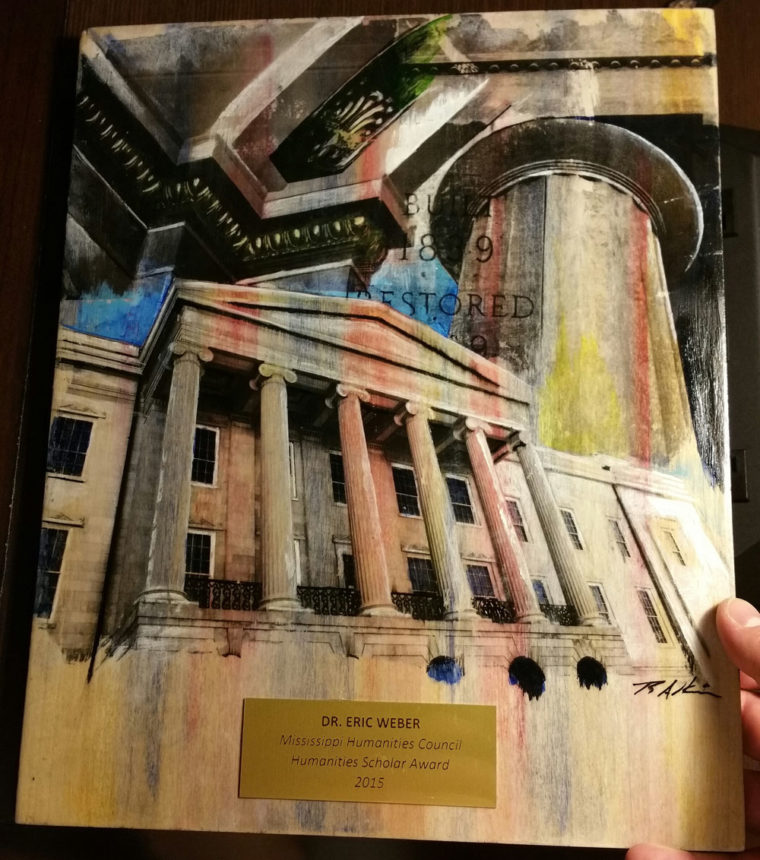
This is the beautiful work of art that the Mississippi Humanities Council commissioned to serve as a plaque for the 2015 Humanities Scholar Award I was honored to receive in February. The event and the honor were deeply meaningful and encouraging.
Receiving the 2012 Thomas F. Frist Student Service Award
It was an honor to have been chosen for the 2012 Thomas F. Frist Student Service Award at the University of Mississippi. PPL graduate Kaylen Addison snapped this great photo of the moment when I was up at the podium to receive the award.
The next pic is the plaque, featuring the university’s colors.
I also got a photo with then-Chancellor Dan Jones, who has been highly encouraging and supportive. In fact, he wrote one of the endorsements for Uniting Mississippi.
A professor from my undergraduate years gave me some of the most important advice I’ve ever received for a career in academia. First, he asked me: “How are you at taking criticism?”
With a bit of a shrug, I said “Ok, I suppose.”
He then explained that “If you can take criticism well, you can go very far.”
He could not be more right. Nonsense criticism needs to bounce off and be forgotten quickly, but most criticisms have substance to learn from. Criticism is a vital means by which we learn and improve. If one can come to want criticism, at least the useful kind, which has some truth to it, then one will continually grow in one’s craft.
“The Law and Morality”
by Cherita Brown, Richard Gershon, and Eric Thomas Weber
This is the interview I gave Cherita Brown of Mississippi Public Broadcasting, MS’s NPR affiliate, and Professor Richard Gershon of the University of Mississippi School of Law on the relationship between the law and morality. Cherita also interviewed me about my forthcoming book, Uniting Mississippi: Democracy and Leadership in the South.
I hope to joint them again soon, as I had a great time. This is just one example of the collaborations I’ve enjoyed with the School of Law at the university, now that I’m an affiliate faculty member there.
Heading to the University of Southern Mississippi to talk about Uniting Mississippi for their Mississippi Humanities Council-supported “Philosophical Fridays” program.
Room TBD, University of Southern Mississippi 601.266.4518
Location:
Hattiesburg, MS 39406
Public:
Public
If you'd invite me to speak for your event or organization, visit my contact page.
Looking forward to visiting folks at the Clinton School for Public Service at the University of Arkansas, in Little Rock, where I’ll be talking about Uniting Mississippi: Democracy and Leadership in the South.





This is the interview I gave Cherita Brown of Mississippi Public Broadcasting, MS’s NPR affiliate, and Professor Richard Gershon of the University of Mississippi School of Law on the relationship between the law and morality. Cherita also interviewed me about my forthcoming book, Uniting Mississippi: Democracy and Leadership in the South.
I hope to joint them again soon, as I had a great time. This is just one example of the collaborations I’ve enjoyed with the School of Law at the university, now that I’m an affiliate faculty member there.