On April 23rd, I will present online on “Fighting for a Culture of Justice in Dark Times” for the Hale Ethics Series at the Rochester Institute of Technology, in Rochester, NY.
Date:
April 23, 2026
Event:
Invited Online Talk for the Hale Ethics Series at the Rochester Institute of Technology
I will be traveling to Fitchburg State University to give a talk in their Anti-Racism Initiative on “Fighting for a Culture of Justice in Dark Times,” regarding my latest book, A Culture of Justice.
More information is coming soon!
Date:
April 17, 2026
Time:
TBD
Event:
Lecture for the Anti-Racism Initiative at Fitchburg State University
A discount code will be out soon for the July release of the paperback edition of 'A Culture of Justice with SUNY Press. Check out my social media pages for that soon.
John Dewey held that education is the intelligent transmission of culture between generations, making the question of culture crucial. While liberalism generally resists intrusion into culture, prioritizing the consent of the governed, Eric Weber argues in A Culture of Justice that society shares a public obligation to create and sustain a culture of justice. Recent state and federal actions ban efforts to make education more equitable and inclusive, illustrating the challenge to a culture of justice as well as the reason why efforts must extend beyond the narrow realm of politics. Political actions matter and must continue, but social, moral, and cultural work is equally essential. Weber outlines practical ways individuals and communities can fight against cultural injustice and for more inclusive and fairer educational environments.
The link in this image goes to SUNY Press’s page for the book.
For those interested in a copy of A Culture of Justice, the book will be out in paperback for the general public in July of 2026 and I will have a discount code available, which I will share on my social media pages, such as on Facebook, X.com, and LinkedIn.
Date:
April 3, 2026
Time:
03:30-05:00 p.m.
Event:
2026 Honi Haber Memorial Lecture @ UC Denver
Topic:
Fighting for a Culture of Justice in Dark Times
Venue:
St. Cajetans (Auraria Campus)
Location:
101 Lawrence Way Denver, CO 80204 USA
Freedom in Education: A Philosophical Critique of Current Educational Policies
Video, 1 hr & 6 mins
This video is a recording of the presentation I gave in Middle Tennessee State University’s Applied Philosophy Lyceum speakers series on November 17, 2023, in Murfreesboro, TN.
The talk is titled, “Freedom in Education: A Philosophical Critique of Current Educational Policies,” and the abstract for the presentation reads as follows:
Parents and guardians are naturally concerned about what their children are taught in schools. Some lament what they feel is a lack of control over curricula and what are thought to be forces or agendas that they believe are not in kids’ best interests. The arguments advanced in recent conflicts take two main forms. The first, advanced in similar fashion on opposing sides of issues concerning gender and early education, takes the form of arguments to “protect” children. The second, typically arising in discourse about desire for exclusion or selection of curricular messages or content, typically focuses on parents’ rights, in particular, to freedom of choice, whether regarding selection of schools, book banning, or inclusion or exclusion of desired or undesirable subject matters from curricula. In this talk, Dr. Weber will defend the importance of students’ and teachers’ freedom and challenge the overreach of dominant parental views that seek to silence the lived experiences and concerns of marginalized groups.
NOTE: At one point, I accidentally said “Transylvania State University,” which was intended to refer to Transylvania University, which is a private institution. This was an accidental case of misspeaking. The point was to contrast with state institutions, which was on my mind, and probably led me to use that word, “state,” resulting in the opposite of my intended meaning… My mistake!
Philosophical Research Methods: This talk was delivered in fall 2023, when I was teaching a course on Philosophical Research Methods in the University of Kentucky’s College of Education. I mention this because in this talk, I describe my methodology explicitly for the project beginning at minute 14 until minute 19. For those interested in that portion of the talk, you can jump to those minutes.
2023 Commonwealth Ethics Lecture at Bellarmine University in Louisville, KY
In the spring of 2023, the Ethics and Social Justice Center at Bellarmine University issued a call for proposals for their yearly Commonwealth Ethics Lecture. They invited scholars from around the state to propose a talk to be delivered for their 2023 lecture, considering approaches from all disciplines and with special interest in interdisciplinary dialogue and topics, encouraging “critical reflection, dialogue, and constructive action on contemporary ethical issues in society.” They also welcomed proposals “related to politics, societal well-being, and individual happiness,” as well as that “intersect these themes with regional issues.”
I pitched my proposal in relation to the fact that Kentucky is a state that continues to permit and make use of corporal punishment in public schools. I have long thought about corporal punishment especially as an example of a practice long outmoded and for which evidence has become increasingly clear that better alternatives are available and that long-term effects of the practice are psychologically and medically discouraged. Given this opportunity, it was a great chance for me to focus on corporal punishment directly, so I jumped at the chance finally to focus extensively on this topic.
Kentucky has decreased the use of the form of discipline in public schools to nearly negligible levels, with 17 recorded instances of corporal punishment in the 2020-2021 school year, which suggests that the practice would not be difficult to end at the state level. Given that, Kentucky could serve as a leader among states that presently permit and engage in the practice, to show how others can follow the lead of the Commonwealth state of Kentucky, to end the practice around the country. The video here above is 1hr and 1 min long, concluding at the end of my talk, not including the question and answer session, though that was fun and rewarding for me also.
I am especially grateful to Dr. Kate Johnson for being a welcoming and great host at Bellarmine University for the talk. The attendance and recording of the talk were great and much appreciated.
VIDEO: Freedom in Education for Diversity of Flourishing
This video was recorded at Vanderbilt University on October 15th, 2022, at the John and Shirley Lachs Conference on American Philosophy. My presentation was titled “Freedom in Education for Diversity of Flourishing.” Here’s the program for the conference. I am grateful to Vanderbilt University’s Philosophy Department for support for my participation in the conference and for permission to post the video.
Or, Be Nice, Not Machiavellian, in Professional Networking
Today, I led a discussion for the department of Educational Policy Studies and Evaluation’s Lunch & Connect series, which we run to keep people connected despite the pandemic. My meeting was titled: “Prepare to Act Naturally! … Or, Be Nice, Not Machiavellian, in Professional Networking.”
For the talk, I created a handout, which is available here: etw.li/networking.
We recorded today’s talk, which you can watch here:
If you enjoyed this video, consider sharing it with anyone looking for thoughts about professional networking in higher education.
In the video, Dr. Kelly Bradley mentioned a resource that I may get ahold of and be able to share with you here, updating this post.
Handout from a talk delivered in the Lunch & Connect Series for the Ed Policy & Evaluation department
Today I led the department of Educational Policy Studies & Evaluation‘s Lunch & Connect meeting on Zoom, focusing on the topic: “Research Trajectories: From Idea to Presentation, to Journal Article, to Book.” I had intended to record the meeting, but due to some of the complication of starting a zoom meeting, making sure people had the link to the virtual handout, etc., I managed not to hit record before starting… Oh well. For today’s session, I made a handout and outline for the meeting I facilitated and led. That outline and handout are available here or by clicking on the Adobe logo on left.
I’m grateful to SpaceX-Imagery for permission to use this image.
The EPE department’s Lunch & Connect series is meant to help us stay in touch with each other during the time of COVID-19. Today, October 16th, was the day for which I signed up and weeks ago I had reached out to graduate students who participate in the Agraphia writing meeting that I run weekly, to ask what they’d like to hear about. This was one of the options that I had thrown out and that received the most votes.
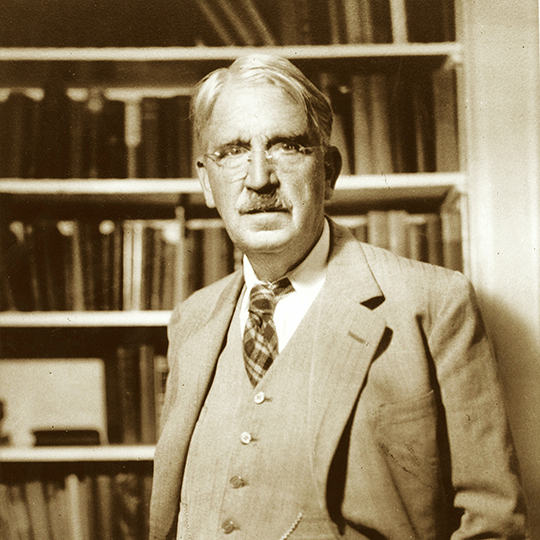
John Dewey.
While the subtitle of my talk reads “From Idea to Presentation, to Journal Article, to Book,” actually it all starts before those smaller matters, with the big picture of one’s aims and career research trajectory. By “career,” I don’t particularly mean to refer to employment, but to the life of one’s research aims. Connecting to the big picture in this way and to who each researcher is represents an outgrowth of John Dewey’s philosophy of education, which calls for recognizing persons’ varied inclinations, interests, and selectivity of attention, as well as their powers, abilities, and attitudes. The big picture need not lead a person to exclude all else, but can allow healthy breaks for divergent projects, while also giving us reasons to watch out for what we often call “rabbit holes.”
I wouldn’t be surprised if I were to give this talk again. If I do so, I’ll be sure to record it. For now, at least, I can share the handout I made for the sake of facilitating today’s meeting. I hope it’s useful.
P.S. If you are interested in studying philosophical issues in education, check out the Philosophical and Cultural Inquiry (PCI) track of the University of Kentucky College of Education’s Ph.D. in Educational Sciences. There aren’t many programs like ours in the country. If you want to learn more, reach out: eric.t.weber@uky.edu.
A Presentation for the Lewis Honors College & for EPE 301 Students at the University of Kentucky
On Tuesday, October 13th, 2020, I was invited to give a talk for the Lewis Honors College at the University of Kentucky on “Undergraduate Research Beyond the Classroom.” This talk is also potentially of interest to students in my EPE 301 course on Education in American Culture. Really, this talk is for any undergraduate who might be interested in taking advantage of opportunities to engage in research or its dissemination beyond the classroom. The handout I used can be opened here or by clicking on the Adobe logo on the right.
Students in EPE 301 can use this video as 1 hour of their field experience observations. The dangers of COVID-19 prompted the creation of this option. Most students are probably not studying the subject of this talk for their papers, but all are working on research in their undergraduate coursework. In that context, students might find the content of this video useful for taking their work beyond the classroom. In addition, students interested in an issue about which they suspect that I could offer some useful thoughts can email me with their questions or comments as part of their field experience work: eric.t.weber@uky.edu.
In the talk, I reference three texts that aren’t mentioned on the handout. Those books were: