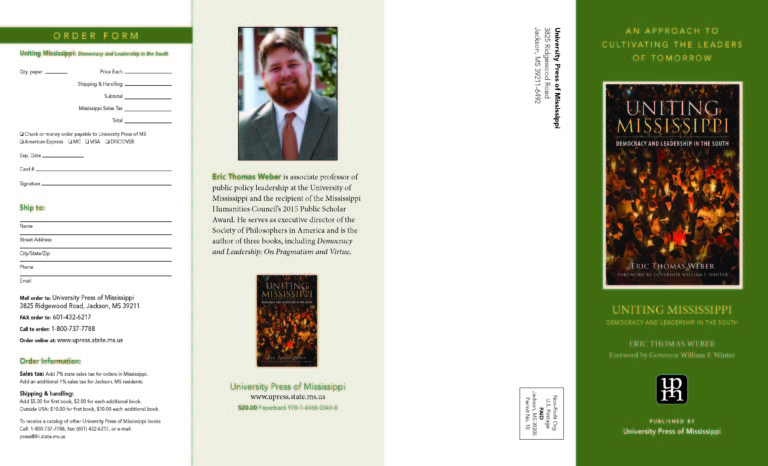

It’s hard for a big institution to show appreciation for all the people who deserve it. Given that, I feel fortunate. The College of Liberal Arts has issued its 2015 ‘View from Ventress’ publication, in which it announced awards over the last year. This past year was an exciting one, as in February, the MS Humanities Council issued me their Public Humanities Scholar award and in September my book came out, Uniting Mississippi.
The college noted both in a very nice piece they put together in this yearly fall publication. If you click here or on the image on right, you can open a PDF of the page with the announcement.
Otherwise, you can open the whole ‘View from Ventress’ file online, opened to that page here. I think the college was very kind with this announcement. On top of that, I think they did a lovely job making the announcement, connecting with the substance of my work. That took care and sincere interest. I feel fortunate and motivated to pass along to others appreciation for what they do, given that it’s nice when folks make that effort.
“Race and Moral Leadership in the U.S. Judicial System,” open forum discussion
“District Judge Carlton Reeves has presided over key race and equality cases in Mississippi.” (NPR) Photo by Jackson State University.
Where: Bryant Hall room 207, University of Mississippi, Oxford, MS
U.S. Judge Carlton Reeves of Mississippi caught national attention with a speech he prepared for the sentencing in a murder trial. The case concerned the racially motivated murder of James Craig Anderson. Reeves’s speech has been called “breathtaking” on NPR.org and has been viewed well over a million times. NPR published a short bio about “The Man Behind the Speech.”
Reeves’s position and leadership are special in part because of his position as a judge. We often think of executives or legislators as leaders. Judges also exercise leadership in their own unique ways and contexts, however. Reeves’s example is also special because of the context of his leadership and the location and circumstances of it. We will have an open forum discussion about “Race and Moral Leadership in the U.S. Judicial System” in Bryant Hall room 207 on Tuesday, October 27th, at 4pm.
Dr. Eric Thomas Weber, associate professor of Public Policy Leadership at the University of Mississippi, will be moderating the discussion.
This forum is free and open to all students, faculty, staff, and community members. Anyone needing accommodations related to disabilities, contact Dr. Eric Thomas Weber at etweber@olemiss.edu.
I was thinking about coffee because I love it, and a silly idea struck me. I’m not a quantitative researcher and the silly activity I spent a few minutes on this morning is utterly unscientific and drawn from sources that confer no serious credibility. Therefore, I urge anyone looking at this not to cite it in any kind of research or writing, unless you’re writing about silliness.
I wondered whether one could show some correlation between growth in coffee consumption and economic growth. Selecting out an inconvenient year before my chart starts, I got a bit of a correlation. Both go up! See?!
It gave me a chuckle, so I thought I’d share. Even if it’s just a silly thought to make me feel better about my dependency on coffee…
The Clinton School for Public Service at the University of Arkansas Little Rock does a nice job of getting the word out about their speakers series. Here’s an announcement in the Arkansas Democrat-Gazetteabout my upcoming talk on Uniting Mississippi, which will be on October 19th at noon in Sturgis Hall.
The announcement has details about the where and when, and an email address plus phone number for anyone who’d like to reserve seats.
Eric Thomas Weber, first published September 1, 2015 in The Prindle Post.
The start of another academic year is cause to reflect on the aims of education and the fact that 19 states in the U.S. still use corporal punishment in public schools. Many have yet to learn the counterproductive and harmful effects of disciplining kids with violence. Nowhere is the mistake more troubling than in our public schools.
‘The board of education’ by Wesley Fryer is licensed under CC BY-SA 2.0 (via Flickr)
I have argued elsewhere against school corporal punishment on grounds of the right to security of person and given the Platonic warning that “nothing taught by force stays in the soul.” The aims of education offer a further, crucial reason why we ought to end the use of corporal punishment in public schools.
What is school for? Somewhere at the heart of the answer should be the idea of educating people to be critical thinkers. John Dewey once argued that such a goal is implicit in the “supreme intellectual obligation.” That obligation calls for empowering all citizens with the scientific attitudes and intellectual habits of mind necessary to appreciate wisdom and to put it to use. Expert scientists must push the envelope of knowledge, but if intellectuals are to benefit humanity, the masses of people need to be sufficiently critical thinkers to benefit from scientific innovations.
Critical thinking involves the development of a skeptical attitude, one which expects or hopes to uncover justification or evidence. It appreciates well-founded authorities, understanding authority as a relationship of trust based on good reasons for it. For schools to cultivate critical thinking in young people, kids need to be comfortable questioning their teachers, administrators, and parents. In public schools, we need safe environments in which intellects are allowed and enabled to experiment, to be creative, and to learn whether and why some authorities are warranted, when they are.
Continue Reading »
I had two deadlines Friday. Made one of them. The grant application is out. I’m so lucky that the other deadline was more flexible. BUT, today’s the deadly deadline… This guy at his desk is me today. MUST get this done. Final edits are due on my latest journal article. The piece is important for my book, A Culture of Justice. It’s first coming out in a journal. Helpful feedback is the best part of journal publishing, not that reviewers are ever encouraging. The important part is that they’re often right about some ways in which I could improve my work.
I’m grateful to artist Oliver Ottitsch (OliverOttitsch.com) for permission to post his artwork, “Deadline” (February 22, 2013), which he kindly granted me. I ordered one of his books today, most of which are in German, though one is in French and one’s in English. The cartoon above is online here.
Oliver’s piece inspires me today, including now, as I do something fun for a few minutes before (instead of) finishing my edits! Back to work!
Mississippi offers a clear example of Plato’s worry about disunity. One of the four virtues that he clarifies in The Republic is moderation, which is important for avoiding the extremes of behavior or of belief. What is most famous about Plato is his conclusion that the good city needs philosopher-kings, that leadership most fundamentally must be guided by wisdom. While that is true, it misses what Plato’s Socrates calls the greatest good for the city, the absence of which yields the greatest evil.
Plato’s Socrates asks “Is there any greater evil we can mention for the city than that which tears it apart and makes it many instead of one? Or any greater good than that which binds it together and makes it one?” Yes, wisdom is the most important virtue in one sense, for Plato, but when it comes to the public good, wisdom should be most concerned about division, and most fervently and wisely striving for unity. Without the latter, a state, divided against itself, only falls apart or fails at its aims.
I am looking forward to visiting the Clinton School for Public Service at the University of Arkansas at Little Rock on October 19th (if you’re in the area, mark your calendar). For those interested, I believe you’ll be able to watch the talk I give there via live Web stream. I should also be able to link to the video of it afterwards. And, as I’ve noted, I’ll give an interview on the Little Rock affiliate of NPR program, the “Clinton School Presents.”
You need to watch this. William Flowers, a man from Georgia, came to a demonstration in Jackson, MS, as a leader in the effort to defend the Mississippi flag, which features an emblem of the Confederate Battle Flag. He leads the self-described southern nationalist group, League of the South.
This interview is not simply someone with a video camera. This is Mississippi Public Broadcasting interviewing a spokesman for the organized protest.
Cartoon posted with permission, copyright Clayton Jones. Claytoonz.com
The man speaks of the cultural attack on southern heritage as a genocide. That is the language and strategy of the Ku Klux Klan. As I mentioned in an earlier post, I returned home from Germany this August to find a message on my answering machine from a Presidential candidate arguing for a fight against the genocide of the white race. This man refers to genocide of southerners, which is novel, at least to my experience.
The argument reminds me of a powerful cartoon by Clay Jones, on right, featuring an African American man carrying a shot child, grieving silently, next to a wailing southern white man carrying his Confederate Battle Flag, in a shape resembling the child on left.
When asked about secession, Flowers openly advocates for it. He is explicitly a secessionist, who then says that he’d prefer a political solution. That sounds like a threat to me.
If you ever needed a demonstration that the Confederate Battle Flag is divisive, this fellow made it crystal clear. He refers to heritage, then dismisses any relation to slavery. He’s unhinged. We have this stuff scanned and online now. Mississippi’s first statement explaining its causes for secession says that slavery was its fundamental cause.
If you’ve visited my site before, you know where I stand on this. If you haven’t check out:
The United States for so long has been a champion of innovation, but because of powerful special interests and also because of some unwise reasons, we are losing a great deal of ground. When I was growing up, we would hear chants that “We’re Number 1!” especially around the time of the Olympics. Americans were proud. We thought, whether rightly or not, that we were or had the best of everything that counted. Travel abroad offers reason for humility. I found a striking example when I visited Germany this past August. There were solar panels everywhere.
The U.S. is known for innovation for a number of reasons. The first is that early on the country was guided by a pioneer spirit. While Europe was strongly controlled by longstanding conventions, in the Americas, so many things were new. Much of the countryside was “wild,” a characteristic that was harmful when ascribed to the native peoples. Considering the wilderness of forests, bears, and other things that could kill you, there was much to do to survive. Innovations were necessary.
Beyond that, as de Tocqueville and later Max Weber pointed out (no relation, by the way), America had an industrious spirit and brought a Protestant work ethic to its industries. While the U.S. had its many troubling capitalist robber barons, it also has long been a land of invention and creativity. It’s remarkable how many inventions came from the United States, like the light bulb, the telegraph, and the telephone.
When you consider that the United States invented the automobile, it seems sad that Ford Motor Company failed to innovate and anticipate the changing market for fuel. With increasing gas prices, which of course fluctuate, demand naturally has risen for smaller, more fuel efficient vehicles. My wife and I bought a Prius. It has a 10 gallon tank of gas, or thereabouts. That might seem small. On that 10 or 11 gallon tank, we can drive 5.5 – 6 hours from Oxford, MS to Altanta, GA. True story. We get there needing to fill up soon, but we get there (I’ve got family there, so we’ve done it several times).
or "Governor, Take Down This Flag," in The Clarion Ledger, September 20, 2015, 2C.
My piece, “Mr. Bryant, Take Down the Flag,” came out in The Clarion Ledger this morning. In the printed version, the title is “Governor, Take Down this Flag.” For the next week or two, please head to the electronic version of the piece on the newspaper’s site. You can download and print a PDF of the article by clicking on the image of the printed version.
The announcement has details about the where and when, and an email address plus phone number for anyone who’d like to reserve seats.