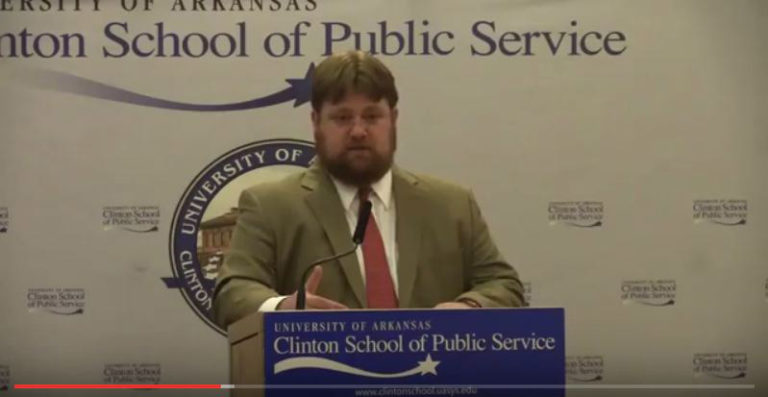
Check out the nice promotional video that the local public television station made in Little Rock (UALR TV) for the recording of my talk at the Clinton School, which they aired. They added music and edited bits down into some representative moments. How cool? The music is great.
Of course the funny thing about sound bites is in examples in which an idea or a contrast is cut in half — when you explain what’s “on the one hand,” and then we don’t hear what’s “on the other hand.” I don’t think the edit misrepresented what I was talking about, fortunately. The promo still got to the heart of what I’m up to in Uniting Mississippi.
I’m learning the importance of planning a few key short statements of my points, which get called “soundbites.” That’s not foolish or superficial to think about, however. Plato’s Socrates often had long definitions of concepts, which he then boiled down into more succinct restatements. I see that. I also make an effort of that kind for my definition of good democratic leadership in the oh-so-cleverly titled Democracy and Leadership.
Anyway, check out this short, 1 min+ promo video. I’m new to this, so it’s still cool and exciting to me. The video of my full talk is here. Soon I’ll also have the audio from my local Little Rock NPR interview. Coming Soon…
Leaders of the John Dewey Society asked me to organize a panel workshop on public philosophy for the 2016 American Educational Research Association meeting. The conference them is: “Public Scholarship to Educate Diverse Democracies.” 2016 is also the 100th anniversary of the release of Democracy and Education. More info once details are finalized.
Walter E. Washington Convention Center Washington, D.C. USA
If you're in D.C. and would like to meet, or if you have a group that is looking for a speaker, visit my Contact page.
Excited to announce that I’ll be heading to UNC Charlotte to give a talk in April 2016. The audience will be made up of folks from “philosophy, American Studies, and perhaps also an interdisciplinary mix of public policy faculty and graduate students.” Sounds great. Some of the details I’ve listed are tentative for now. I’ll post more definitive details soon.
I’ve tried my hand at a few new kinds of public engagement efforts that have borne fruit. The latest example for me is in seeking TV interviews to talk about issues in public philosophy, particularly some ideas about how I think Mississippi could benefit from good democratic leadership. I’m headed to Tupelo, MS for an interview on WLOV’s This Morning show, Wednesday, November 18th. Then, on Monday, December 7th November 23rd, (updated), I’ll be heading to Biloxi, MS to give an interview on WLOX’s News at 4 show. After each I’ll be holding a book signing, though only the one in Tupelo has been scheduled at this point.
Scholars or readers curious about higher education may wonder: why do all of this? We certainly have enough work to do teaching classes, researching and writing, applying for grants, and serving our institutions and professional associations (the work of a professor is a lot more than what folks see in the classroom). Why add on to that with “outreach” or public engagement?
In “The Search for the Great Community,” from The Public and Its Problems, John Dewey argues that democracy’s prime difficulty has to do with how a mobile, complex, and many layered community can come to define itself and its interests. He believed that the key to addressing democratic challenges was to make use of democratic means, particularly communication. Democracy can embody wise leadership, but only with widespread, maximally unhindered communication, especially emphasizing the developments of human knowledge — the sciences, broadly speaking. For that reason, it is a clear and crucial extension of his democratic theory to value the public engagement of scholars with their communities.
When Dewey referred to public engagement, however, that did not mean only a one-way street. Communication takes listening too. So, the point isn’t only for scholars to speak to audiences, but for them also to learn from the people. When I write, I draw increasingly often from newspapers and magazines to illustrate my points about what people are saying and experiencing beyond the academy. Scholarly research is vital, but so is the world beyond the academy. Some circles have criticized me for it in peer-reviews, but so far I haven’t let that dissuade me from seeing scholars’ task as needing to draw also on sources and input from beyond the academy. In addition, talking with people around Mississippi and in other states about my work has revealed all kinds of interesting insights. Some people offer me great examples that I can use to strengthen my points. Others highlight challenges for bringing about the kinds of changes that I believe are needed.
Earlier that morning, I’ll be giving an interview on WLOV’s This Morning show in Tupelo, MS. If you’re in Tupelo that day, the signing will be at lunch time, so come on by!
Public Policy Leadership alumn Elliott Warren kindly sent me a link to this maiden address from Senator Ben Sasse, Junior Senator from Nebraska (R). It was an incredibly kind compliment for Elliott to say that this Senator’s speech reminded him of my classes here at the University of Mississippi. Senator Sasse calls for a renewal of the virtues of deliberation that the Senate is supposed to embody. He explicitly points to Socrates for insight, and to the methods of Socratic dialogue. He calls on his colleagues explicitly to avoid straw man fallacies and other errors of reasoning. It was the most elegant speech I have heard from a Senator in years.
The speech is 29 minutes long. You may not have that time right now. At some point, though, you will be glad that you watched Senator Sasse’s speech. I urge you all to find the time. Here’s his speech on C-SPAN.
Originally published in the Oxford Eagle on October 28, 2015. Republished with permission.
Lyndy Berryhill, Oxford Eagle.
I’m grateful to Lyndy Berryhill of The Oxford Eagle, who came to our forum with Judge Reeves. She also kindly gave me permission to republish her piece on my page here. Thanks again to the Mississippi Humanities Council and to the College of Liberal Arts for their support for the event! Thanks to Berryhill for coming and letting people know about the event. There’s so much to be proud of in Mississippi. It’s crucial that we talk about that more often. Here’s her piece:
Judge Carlton Reeves, photo by Lyndy Berryhill of the Oxford Eagle, 2015.
In the wake of racial discussions on campus, the University of Mississippi provided students with a speaker to talk about Mississippi history and racial violence in the state.
District Judge Carlton Reeves has presided over key race and equality cases in Mississippi
U.S. District Judge Carlton Reeves spoke on “Race and Moral Leadership in the U.S. Judicial System.” Tuesday afternoon in Bryant Hall.
“Mississippi has struggled with its past, but it has also struggled to move forward,” Reeves said.
Reeves famously presided over the racially charged murder of James Craig Anderson and later sentenced his murderers to prison. NPR called his speech at the trial “breathtaking” and it garnered Reeves national media attention. During the forum, Reeves talked about the case and how it was important for people to realize what a hate crime is.
Photo by Lyndy Berryhill of The Oxford Eagle, 2015. Posted here with permission.
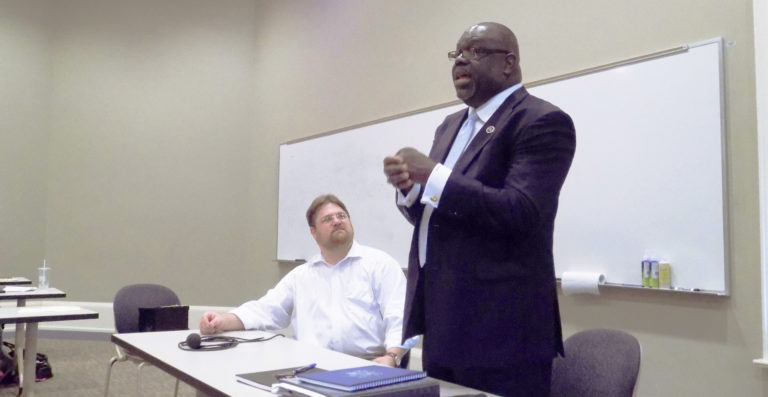
Judge Reeves’s talk and visit to my class went better than I could have hoped. Here’s a great article that the Oxford Eagle published about the open forum discussion, which was sponsored by the Mississippi Humanities Council.
Thanks to all who came and thanks to the College of Liberal Arts, the Winter Institute for Racial Reconciliation, and the Mississippi Humanities Council.
At the Clinton School for Public Service, on Monday, October 19, 2015 at noon.
I am so grateful for two lovely introductions, one from Dean Skip Rutherford of the Clinton School and a former student of mine studying there, Rob Pillow. This video includes only the talk and Q&A. If I can get their intros, I’ll post them too. The Clinton School folks are excellent at what they do and were wonderful hosts. Here’s the video of my book talk:
Where: Bryant Hall room 207, University of Mississippi, Oxford, MS
U.S. Judge Carlton Reeves of Mississippi caught national attention with a speech he prepared for the sentencing in a murder trial. The case concerned the racially motivated murder of James Craig Anderson. Reeves’s speech has been called “breathtaking” on NPR.org and has been viewed well over a million times. NPR published a short bio about “The Man Behind the Speech.”
Reeves’s position and leadership are special in part because of his position as a judge. We often think of executives or legislators as leaders. Judges also exercise leadership in their own unique ways and contexts, however. Reeves’s example is also special because of the context of his leadership and the location and circumstances of it. We will have an open forum discussion about “Race and Moral Leadership in the U.S. Judicial System” in Bryant Hall room 207 on Tuesday, October 27th, at 4pm.
Dr. Eric Thomas Weber, associate professor of Public Policy Leadership at the University of Mississippi, will be moderating the discussion.
This forum is free and open to all students, faculty, staff, and community members. Anyone needing accommodations related to disabilities, contact Dr. Eric Thomas Weber at etweber@olemiss.edu.
Photo by Lyndy Berryhill of The Oxford Eagle, 2015. Posted here with permission.
Thanks to all who came and thanks to the College of Liberal Arts, the Winter Institute for Racial Reconciliation, and the Mississippi Humanities Council.